Recently in Gardens Category
Sunset posts maintenance information each month online with tips on what to do in the garden.
Looking at the landscape setting of the new De Young is a bit of mixed bag. Berkeley professor of Landscape Architecture Walter Hood sets the landscape as an understated collaborating piece to the architecture that is the true focus of the new museum. In some regard this is to be commended. The wild hills of poppies and ferns along the rear of the museum blend well with the feel of a wild and bohemian (under-maintained) Golden Gate Park.
Hood confirms this impression: "In a way the building [the new de Young Museum] is so loud that no matter what you do in the landscape it's not going to be as loud as the building. At first I thought the landscape has to be its own thing, but there's just no way it can be. It's not large enough; it's working at this in-between scale, in between the park and the building. How do you make this landscape an in-between space?" [Pruned Blog]
There are interesting detail elements: stained black wood mulch, chips and chunks of black stone mulch, a fence constructed of twigs and leaves. Inside the museum is an intriguing fractured bluestone entry (by Andy Goldsworthy), and a sculpture garden (with installation from light artist James Terrell) under the large cantilever of the museum that projects to the west.
Yet, somehow the grounds of the new museum do not live up to the architecture. Part of this may be remedied with time and growth. The landscape and sculpture gardens do not have the same dynamic interaction, quality, and balance of a museum like the Getty. This is hardly a fair comparison from a monetary or spatial standpoint. Still, it seems the landscape could have been used to better effect.
The sculpture garden seems too small, plant selection in places seems to be struggling (Kafir lily, Camellia, and Ferns among others), and the landscape area and fountain to the east side are much more pleasing in plan view from the museum’s tower than they are on the ground.
In a park clearly showing its age and slowly being reborn, it will be interesting to see how the new addition of the De Young landscape matures and ages. Will it become like Union Square- a garish collaboration of materials with little usability and durability. Or, will it mature into a graceful backdrop to the slow patina of the new museum it seeks to dress- time will tell.
For More:
-The Hybrid Spaces of Walter Hood
-Pruned Blog- "The Peacemaker"
-Walter Hood
Design
A
Coast Redwood with stunted growth as a result of salt exposure near the
coast
The
beautifully rugged Mendocino coast
Castles do not just grace medieval Europe. The Japanese Castle was a thriving architectural form in medieval Japan as well. The most striking example of Japanese castle building is Himeji Castle a UNESCO world heritage site. Within Kyoto, Nijo Castle is another striking example of Japanese castle construction. From a landscape perspective, the layout of Nijo's gardens, moats and impressive stone walls create an interesting contrast from the multitude of temple and shrine gardens in Kyoto.
Nijo's most striking aspect is the bone of most Japanese gardens, its amazing stone work. Both the boulder arrangements and castle walls are amazing.
For More:
City of Kyoto Brochure for Nijo Castle (Part 1 & Part 2)
Jgarden.org
profile
Wikipedia article
Daisenin is the more enigmatic garden counterpart to the clean lines of
Ryoan-ji. Another “Zen Garden” with its dry raked gravel, Daisenin has an
intimacy and series of boardwalks that give a serial, sequential feel to its
spaces. The piles of gravel in the main garden have the appearance of a hybrid,
somewhere between that of Ginkaku-ji perfection and Ryoan-ji gravel and
stones.
For more:
Great Analysis of the Garden from Jgarden.org
Japanese Based Page with good information on the
evolution of the Japanese Garden
Ryoan-ji (meaning "The Temple of the Peaceful Dragon") is the archetypal Japanese rock garden (read more about rock gardens in this past Post). The small table top rock gardens that have become popular owe their inspiration in part to the 15th century anonymous karesansui masterpiece of Ryoan-ji. The garden has a unique axial configuration, so that, from any fixed point on the ground, one cannot see all of the stones in the garden. It is the ultimate rock garden of contemplation.
For More:
Profile at JGarden.org
Article from New
Scientist about Ryoan-ji's appeal
Reflections on Ryoan-ji from Salon
Article about adding elements of Zen Garden design to
garden projects
Kinkaku-ji, or the Golden Pavilion is another of
Kyoto's most famous historical pieces of architecture (in 1994 it was designated
a UNESCO World Heritage Site). It is interesting to contrast Ginkaku-ji, with
its large Silver Sea of gravel, with the layout and actual pond of the Golden
Pavilion.
The Silver Pavilion of Ginkaku-ji was an homage to the more elaborate Golden Pavilion. Historically, however the Silver Pavilion holds significance as an original structure, whereas the Golden Pavilion has been reconstructed after being burned in 1950.
The fusion of architecture and the surrounding landscape in these temples and shrines is amazing. It is interesting how Frank Lloyd Wright's methodology of organic architecture parallels the incorporation of the design and layout of the building to its surroundings in a similar way to these Japanese pieces.
For More:
Kinkaku-ji official site
Wikipedia article
Kyoto the historical capital of Japan (prior to the move of power to Tokyo in
the 19th century), is a striking city full of history and captivating gardens.
One of the best preserved major cities in Japan (surviving World War II), it
features a wealth of shrines, temples and gardens.
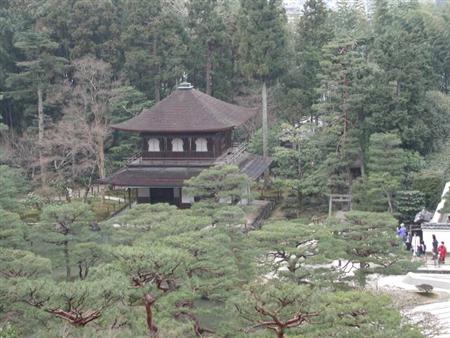
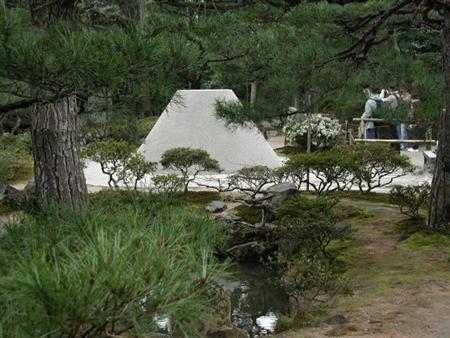
The Silver Pavilion, or Ginkaku-ji, is one Kyoto's most famous temples and houses one of the city's greatest gardens. The striking piles of raked and formed mounds of gravel and stone are wonders to behold. The Silver Pavilion itself is a rare original example of architecture from its period. Often temples and shrines were burned by feuding Shoguns and many have been reconstructed numerous times.
The entrance to the temple complex features a two story Camellia hedge, precisely clipped and indicative of the meticulous nature of the gardens inside. Once inside the Karesansui forms are like nothing else in the gardens of Kyoto. The craft here is amazing, and the raked gravel takes on an appearance of solid mass that should be impossible.
For More:
Check out the Ginkaku-ji Official Site (in English) with an
interactive map and detailed history of the temple
Details from Wikipedia
Jgarden.org index of Japanese Gardens
This is a good thing to watch for when looking through these magazines. That beautiful plant in the featured article looks great, but is it evergreen or deciduous? Does it require low or high maintenance? Is it something that deer find to be equivalent to caviar? Often the planting compositions are complex blends of grass, perennials and annual flowers, that look great but require heavy maintenance.
The same can be said for hardscape. It is my experience that expensive, large projects photograph for print publication the best. Before you set your heart on that 1000 square foot travertine patio with vanishing edge pool and outdoor kitchen, take into consideration what it would take to install these type of elements for your project.
A good example was a client who wanted Golden Barrel Cactus, similar to the distinctive garden at the Getty Center, until we priced them out, and found that the cactus alone would exceed their planting budget.

At several hundred dollars a piece these golden
barrels might break the bank
Plus, at the size of an oversized brick, this compact yet dense volume can serve well if the reader is accosted by a dinner guest who has had a bit too much wine.

Cover Image Courtesy Amazon
Have a great Thanksgiving!

The
Cover
Some
of the Monthly Images

Winery gardens vary in their scope and style, but many tend to be of Mediterranean/Italianate villa inspiration and incorporate fountains, outdoor dining areas, and a wide variety of plants and materials. For smaller residences the budget may not be the same as a large winery, but cues for stylistic elements abound.
For more:
Healdsburg Area Wineries
Sonoma County
Wineries Assocation
Posted by Michael O'Connell at 08:46 PM | Comments (0)
Project Type:
Retail sustainable goods outlet/ Non-
Profit Institute for solar and sustainable technologies, 12 Acres in size
Designers:
Architect: Sim Van
der Ryn
Landscape Architects: Stephanie Kotin and Chris
Tebbutt
Completed June 1996
Contact:
Website: http://www.realgoods.com/
Address: 13771 South
Highway 101 Hopland, CA 95449
Phone: (888) 212-5640
Project Background:
The Real Goods Solar Living center is
the vision of John Schaeffer, the founder of the sustainable products company
Real Goods. Located about 90 miles north of San Francisco, the center
encompasses three distinct elements: The 5000 square foot Real Goods retail
store, the Solar Living Center- a non-profit educational and research division
of Real Goods, and Solar 2000, a 132 kilowatt solar array, which is one of the
largest solar power sites in Northern California. Real Goods is a mail-order
based company, which had over 18 million dollars in sales in 1996 when the
center opened. The project was built as a model for the use of sustainable
energy technologies, building materials, and a showcase for the company’s
products. The Solar Living Center manages the facilities and grounds and focuses
on educational workshops and continuing research. This includes the promotion of
sustainable building materials and techniques, permaculture, and sustainable
landscape design.
Project Design:
Sustainable design of both the
architecture and the landscape was of foremost importance for the center. The
site selected along Highway 101 in Hopland, lies in a 20 year flood plain and at
the time of purchase was a CalTrans dumpsite. The husband-wife landscape
architecture team of Stephanie Kotin and Chris Tebbutt transformed what was a
bare, noisy site into an interesting and lush oasis with as much landscape
meaning as interesting form. Solar energy panels are built into and featured
within the grounds of the center and incorporate the ideas of sustainable energy
use directly into the landscape. Distinct design elements such as incorporation
of the cardinal directions as distinct axis, a solar calendar, a central
artesian well and stream, and a large pond and wetland are all designed together
into an inclusive package, rich with symbolism and artistry. Throughout the site
individual design elements speak to the message and artistic quality of the
grounds. One poignant example of these elements is the Memorial Car Grove. The
grove contains old rusting muscle cars that have had holes cut in the roofs to
allow trees to grow through. Elements such as this show a rich synthesis of
message with form.
Sources:
-A Place in the Sun- the book about the creation of
Real Goods
-Personal Site Visit
For More:
-Review of A Place in the Sun
This is not to say that the Getty Center is a failure or is not a great facility, for indeed it truly is amazing by any circumstances. However, having been to the likes of the National Gallery in Washington D.C. and the unparalleled Louvre in Paris, my expectations for the Getty were high when I visited one sun scorched afternoon. The main problem observed with the Getty is its inability to put its many and complicated parts together into an effective whole. Among the major observed problems were a lack of unity of buildings and a poor interrelation between the buildings and garden.
First of these faults is the poor cohesiveness in the built form. Meier’s architecture attempts to be overpowering and grandiose with its modernist and classical allusions, yet it lacks the bold vision that would have made it successful. Architecturally the buildings seemed to be too concerned with alternating forms and materials than in really making one statement. Meier has his buildings undulating and changing between a variety of different basic forms; this is in addition to changing materials between travertine rock and aluminum paneling, which is distracting and detracting. The result is a building that makes no clear statement, and whose facades look as if they were two designs melded together. It might have been better if Meier had gone with more modernist ideals of simplicity and purity in form. In this way the Getty Center might have had a more universal and powerful appeal.
The overall composition of the center also shows weakness in the relationship between the gardens and buildings. The gardens of the Getty make their own statement that intentionally veers from Meier’s vision. The designer of the garden Robert Irwin had many fights with Meier over form and relationship of the garden. Ultimately Irwin chose his own independent design vision. While Irwin’s garden by itself is quite impressive it fails to hold its own and blend successfully with Meier’s buildings. The gardens do not have equal footing with the buildings, and as a result the garden is put in a subordinate and not a complementary role. Its forms while interesting and effective, do not play off the architecture in an effective manner.
Overall, the Getty Center is an impressive complex and is obviously poised to make a huge contribution to the world of art. Yet from the standpoint of form and space it leaves much to be desired. It seems as if the Getty Trust tried to do a little bit of everything and lacked focus in making the place exude one expressive and unifying feeling. Unfortunately Meier could not do what I.M. Pei did for the Louvre. Pei was able to combine design theories, philosophies and histories, as well as differing forms into a bold and unique design expression. Meier and the Getty Center did not succeed to the same degree in their pursuits, and this lack of unity detracts from the Museum’s experience.


For More:
Getty Center
Website
Richard Meier & Partners Website
Sources:
Perl, Jed. “Acropolis Now.” New Republic 26 Jan. 1998: 25+.
Beardsley, John. Earthworks and Beyond. New York. Abbeville Press. 1998.
The gardens at the Powerscourt estate embody many of these characteristic
elements very well. Powerscourt stands out by being different than many other
famous Irish gardens. The gardens are important in that the overall design is
very formal, they incorporate these formal traits in a way reminiscent of
Italian and French garden design, and they bring together all these varied and
complex traits into a cohesive whole.
Upon examining the typical Irish garden, it becomes clear that the Irish did
embrace the more pastoral romantic landscapes of England that began to develop
at the beginning of the 1700’s. These influences clearly had a great effect
especially on gardens of the ninetieth century, and it is this more informal
style that tends to dominate Irish landscape design of the most famous gardens.
It is this tendency toward the more organic designs of English style that causes
such a distinction and contrast in the fewer formal Irish gardens. This is not
to say that formal gardening was not a part of the design vocabulary of Ireland,
for it was. Victorian designers such as Sir
Charles Barry and William Nesfield were using elements Italian style in
their garden designs as the backbone of their work. Yet those landscapes of
particular distinction and fame in Ireland follow the path laid by famous Irish
landscape gardener William Robinson. Robinson’s effect on the design
theory of Ireland was similar to the more famous English names of Wise, Kent, Brown and others who pushed the transition to the
Romantic, free-flowing, naturalistic garden. As a result the Irish garden, never
fully developed an articulated formal style that gained widespread recognition
like the more natural gardens that would follow. Still, there were exceptions to
this overall trend in development of garden theory, and the gardens at
Powerscourt are one of them.
Situated fifteen miles away from the capital
city of Dublin in Wicklow County, the estate was the home of the Viscount of
Powerscourt. Encompassing at its peak 36,000 acres, the estate was quite large
and provided great opportunities for building and landscape formation. The
existing estate was finished in 1770, (although the interior was burned out in a
fire in 1974), and from that point the rest of the grounds began to develop. The
sixth Viscount of Powerscourt began development of the grounds as a start of
their eventual modern form, but it wasn’t until his son Richard, the seventh
Viscount of Powerscourt, took over the estate after his father’s death, that
estate’s grounds really begin to metamorphose. Through a somewhat complicated
series of designers and incarnations, the grounds surrounding the Manor began to
take on the shape that they still retain today.
The gardens owe they’re splendor and grandeur mainly to this principal
patron, Richard Wingfield the seventh Viscount. His travels to the gardens of
Europe, especially those to Versailles, Schönubrunn, and Schwetzingen, had a
profound impact on the overall form of the garden. It is because of these
travels that the gardens at Powerscourt show such interesting similarities with
these more mainstream gardens and their design elements and philosophies. The
gardens at Powerscourt, like Irish gardening in general, incorporated all these
influences while maintaining an individuality that gives the grounds a
uniqueness and overall sense of place.
The actual design work of Powerscourt
was done by a number of designers starting with architect Daniel Robertson. It
was Robertson’s overall vision that would set the backbone for what Powerscourt
would become. Robertson worked for the sixth Viscount and although he and the
Viscount would die before they’re plans were realized, the foundation was set
for what was to occur next. Robertson was responsible for the layout of the
rounded series of terraces and the incorporation of the existing water elements
in the overall design. Robertson also was responsible for the formal Italian
design of the gardens that he supposedly emulated from the Villa Butera in
Sicily.
The transition in designers following Daniel Robertson’s death meant a fourteen year reprieve from development and it wasn’t until 1854 that the Viscount’s son and Scottish gardener Alexander Robertson (no relation) would team up and continue development of the estate. Alexander Robertson continued and adapted the vision of his predecessor and development progressed. It was under the steady hand, and bold vision of the new Viscount that work continued although Alexander Roberson also died in 1860. The Viscount then entertained plans from four other designers, and the combination of their work continued to develop the project and its specific details. The first of these was James Howe who continued to develop the semantics of the terraced gardens, and who unfortunately died a year after his Powerscourt plan was created. Later designers followed including Broderick Thomas and Lord Powerscourt’s neighbor Sir George Hodson. These designers continued to articulate the gardens as the design process foraged on.
The result of these no less than six designers and the two lords was nothing less than fabulous. Through its development, Powerscourt developed into one of the most distinctive and interesting gardens in Ireland, and for that matter in Europe in general. The site was a microcosm of European design styles, yet with the unique setting of the rich chromatic green of the Irish landscape, and the backing of Sugar Loaf mountain in the distance the estate achieved something more than its individual design elements could ever achieve alone. Distinctive elements of the formal gardens include a beautifully constructed perron designed by Francis Penrose. The perron evokes visions of Italian designs in its style and beauty, using scores of small stones of black and white set eloquently into the terraced steps. This and other elements enriched the gardens’ already strong formal European feeling. Copies of many famous statues like the Hellenistic Greek statue of Laocoon, ornament the many terraces of the grounds and give the gardens a very continental flavor reminiscent of other famous formal gardens such as Vaux le Vicomte.
Detail is present everywhere in the site, from the beautifully crafted
statuary to the magnificent intricacies of contorting wrought iron shaped in a
multitude of elegant forms. Two bold statues of the winged horse Pegasus accent
the central pond and are very distinctive in design and have their origins in
the Powerscourt coat of arms. Beauty abounds and there is a good cohesion in
site between built form and landscape. The landscape functions well as an
overall setting and extension of the manor.
Here at Powerscourt is the
unheralded Irish formal garden in all its glory. It is this somewhat unique
niche of formality that gives Powerscourt its distinction and importance. The
garden succeeded in creating a formal atmosphere, and yet with additional
gardens such as a Japanese garden addition, and a flawless integration with the
more informal countryside and other informal gardens, there was a creation of
something larger. With its unique setting and properly fit elements, Powerscourt
transcends the ordinary; and when on site or looking at photographs it can
become an almost surreal work of art.
The gardens succeed in carrying on the tradition of the Italian Villa and French Chateau. Renaissance architect Alberti would be proud, as the estate conforms wonderfully to his guidelines for villa planning that a site should be oriented towards “familiar mountains”, such as are found in Sugar Loaf looming picturesquely in the distances that lie beyond as Alberti put it, “the delicacy of the gardens”. It has the open feel of Versailles while at the same time combining the curvilinear themes of the romantic pastoral English designers using its contextual setting. It is a work of combination, done perfectly to create something that is more than its individual styles. The gardens don’t have their own distinct style, and yet they do in their inclusion of all the aforementioned elements. It is in this characteristic that Powerscourt achieves greatness. It is the unlikely formation of a great formal garden in a country not known for its articulation in this aspect of garden design. This contrarian gesture of design against the popular preconception of the Irish garden is what makes Powerscourt grand.

Sources:
1. Hyams, Edward. Irish Gardens. London: Macdonald, 1967.
2. Malins, Edward, Patrick Bowe. Irish Gardens and Demesnes from 1830. New
York:
Rizzoli,1980.
The Japanese rock garden is like a poem, free to interpretation by anyone who cares to venture an opinion and in this aspect lies part of its strength. A child may see a sandbox, an intellectual, the metaphor for perfection in the universe, the Zen philosopher may see just rocks. Most critics consider Ryoan-Ji as the prototype for the rock garden. All of 15 rocks and 330 square meters create the masterwork of Japanese Kare-sansui, or dry gardening. This reinforces the fact that Japanese rock gardens are not gardens of massive size or physical complexity. Their overall significance lies on a transcendental plane.
The contrast to western styles and meaning may also shed some light as to their popularity. The typical garden design philosophy of most western gardens is that of central meaning and conceptual philosophy. The Japanese garden reflects more of cryptic and deeply philosophical thought. There is no greater statement than saying nothing at all, for it allows the mind to complete the scene. The rock garden is an allegory, yet one with a meaning that is as elusive as the meaning of life itself.
Another interesting caveat in Japanese rock gardening is the symbolic raking of sand as a symbol for water. This aspect has allure in its interactivity and in its interesting patterning. What’s particularly interesting about this element is its entry into American culture through small Zen rock kits. A piece of cardboard, some sand, a few small stones, and a rake is all that is needed to achieve ones own inner enlightenment. While there is commercialism and often a lack of full understanding that often accompanies the use of these kits, they show the general appeal of the concept and basic philosophy.
The rock garden then is a place of thought and a place for reflection and meditation. Through its simplistic forms it provokes thought, reflects the design concepts of an entire genre of gardens, and gives a clue into Japanese Zen and naturalistic philosophies. Dynamic yet simple, full of contrast, the rock garden speaks volumes with every grain of sand. Unique in character and quite recognizable, it has maintained its appeal as garden form, and continues to fascinate people, as it will for generations to come.
Kyoto's Famous Ryoan-Ji
Sources:
Moore, Charles, William Mitchell, William Turnbull Jr. The Poetics of Gardens. Cambridge. MIT Press. 1988.
Bring, Mitchell, Josse Wayembergh. Japanese Gardens. New York. McGraw-Hill.
1981.
Visit Cornerstone's Website for more information on the Gardens and their
designers.
In the California and the West Galleries there are 15 galleries from gardens, parks and city spaces from British Colombia to Southern California. In the Western Europe Galleries there are over 20 galleries from 7 countries.
We hope that these galleries can serve as an information resource, and that they will be enjoyable to browse through. As with any web based project there is more on the way from Western Europe, and eventually from our travels in Kyoto Japan and surrounding areas.
The garden itself has a characteristic Spanish quality of being relaxed and a bit wild and overgrown. This is true of many of the other parks of Madrid that I visited. Below are some photographs-
As far as floral displays, from my travels these gardens may only be rivaled
by the Butchart Gardens in Victoria, British Colombia.
Below are some of my favorite photos from the gardens:


A Garden is a thing of beauty and a job forever.
-Anonymous
Nothing is more completely the child of art than a garden.
-Sir Walter Scott
I don't know whether nice people tend to grow roses or growing roses
makes people nice.
-Rowland A. Browne
The great challenge for the garden designer is not to make the garden
look natural, but to make the garden so that the people in it will feel
natural.
-Lawrence Halprin
But a weed is simply a plant that wants to grow where people want
something else. In blaming nature, people mistake the culprit. Weeds are
people's idea, not nature's.
-Anonymous
Again rejoicing Nature sees
Her robe assume its vernal hues
Her
leafy locks wave in the breeze,
All freshly steeped in morning
dews.
-Robert Burns
As is the garden such is the gardener.
A man's nature runs either to
herbs or weeds.
-Francis Bacon
The nation that destroys its soil destroys itself.
-Franklin D. Roosevelt
Unless you take care, the sun will pin you down. Put a hat on that
foolish head of yours when you go out into the fields.
-Farmers
Almanac
He who plants a garden, plants happiness.
-Chinese
Proverb
There is nothing pleasanter than spading when the ground is soft and
damp.
-John Steinbeck
What I enjoy is not the fruits alone, but I also enjoy the soil itself,
its nature and its power.
-Cicero
We collect great garden quotes, let us know some of your favorites.
If you are looking for more good quotes try:
Wisdom
Quotes
Quote Garden
For good local examples of Japanese gardens this may be a good place to visit. The garden is only open to spa guests, except when they have special events, such as concerts- check the Chronicle Article for more details.
Making an authentic looking Japanese garden is not an easy task. I took a
trip to Kyoto in 2001 and after seeing the real thing it is easy to spot
imitators. You can view two of the better examples of Japanese Gardens in our
Great Gardens portfolios for the Portland Japanese Gardens, and the San
Francisco Japanese Tea House in Golden Gate Park.
The estate itself is a Georgian Mansion, which to me did not jive with the
mixed Oak Woodland of the peninsula where it is located. But I was not there to
see the Mansion.
The garden was a great mix of plantings, hardscape and water features and I would recommend them to anyone wanting to visit a great garden in the Bay Area. It is clear why Filoli is considered one of the great estate gardens of California.
See the photos below, and I will work on a larger gallery for our Gardens and
Parks Section
http://www.oclandscape.com/gardens/gardens.htm
Filoli http://www.filoli.org