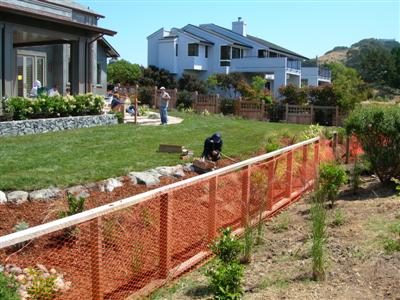
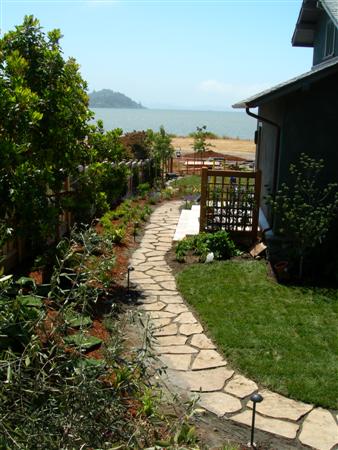
Here is a conceptual layout for a carport arbor for a project in Sonoma for a project in design:
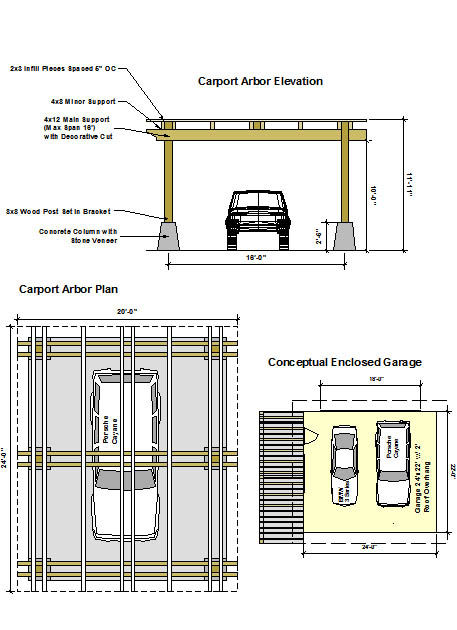

Here is a conceptual layout for a carport arbor for a project in Sonoma for a project in design:
While attending the awards banquet for the San Francisco Chapter of CLCA a couple of weeks ago, I had a chance to talk with Mark Shepherd from Current Cutting Technology. Mark uses a high pressure blast of water, along with digital equipment to cut shapes and interesting tessellations out of stone. The result is that there is no cutting required for a wide variety of unique and interesting designs. His website is definitely worth a visit if you looking for an interesting design flourish for a stone patio, without the hassles of cutting stone on-site.
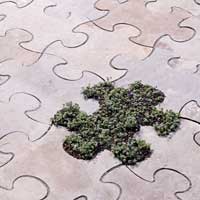
Image from Current Cutting Website
After talking with a prospective client recently, an issue came up that can frequently be confusing when installing a new landscape- how much is it going to cost?
There is no easy way to answer the question, or any absolute formula or cost per square foot to apply that can give a perfect idea of cost. Yet, landscaping is a big ticket item, similar to buying a car; you wouldn’t go to the dealership not knowing if you wanted a Honda Civic or a Porsche.
Landscaping is often not too different in terms of time required, labor required, and material cost required, than some remodeling projects done in the home. You can spend easily $10-20,000 remodeling a 150 square foot bathroom; a 5000 square foot yard done with similar eye for detail is not going to be in that price range.
With that in mind, here is a simplified overview of costing, to give a general idea of what landscape projects cost.
Cost for a project is related to a variety of factors:
1- Site work: How much grading, clean-up, tear out work is involved. How hard is it to access the site and do the work. Can a Bobcat be brought in or does everything have to be done by hand?
2- Infrastructure: How much work is needed on the underlying systems- drainage, electrical, irrigation, lighting. Are there spaces that need to be created with large retaining walls that require drainage and a lot of site work?
3- Hardscape: Usually the most expensive aspect of the project. What are the sizes and lengths of retaining walls required (typical cost $100-400+ per foot), what are the sizes and finishes of patios (concrete, brick, stone?), walkways and flatwork (typical cost $10-40 per square foot). Are there arbors, fences, or gates required?
4- Softscape: How much planting, soil prep and mulching needs to be done? Are plants going to be installed small and allowed to grow, or brought in already mature (e.g. Box Trees)?
5- Accessory features: Are lighting, water features, firepits, or outdoor kitchens desired? What is the scale and level of detail of these items (Are you looking for the Trevi fountain in Rome or a pre-cast fountain that will fit by the back door?).
When Setting a Budget keep the following in mind:
1. Decide what benefits you are going to receive from the new landscaping.
2. Ask friends and neighbors what they spent for their landscape projects.
3. Determine if there is going to be phasing of the project and think about the total scope, detail and cost of the items associated with the project.
From a general perspective most projects that we do in Marin would probably fall into the following categories (all projects pictured are in the upper half of their respective categories):
Small Landscape: $20,000-40,000
These projects that are either on small lots if landscaping both a front or back yard, or focus on a particular area such as just the front or back yard. The design is articulated, but there are not a lot of detail items and accessory features. If those features are present they are typically of smaller scale. If projects are more articulated at this scale it is typically because there was less site work, excavation/retaining, and infrastructure work needed.
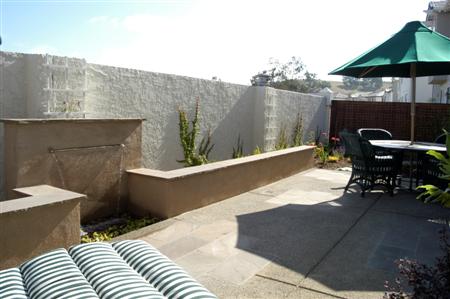
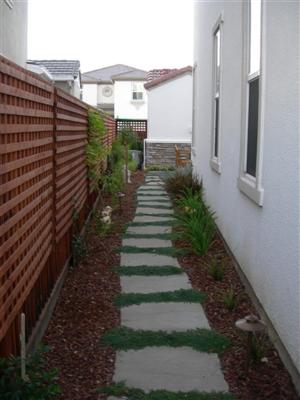
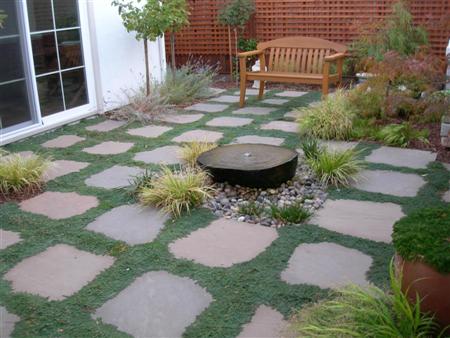
Small project above included: Irrigation system, small 150 sq.ft. flagstone patio set in sand, border accent plants, back concrete patio with stone accents, seat wall and waterfall. A project at the bottom half of this category would probably have about half of these elements.
Medium Landscape: $40,000-75,000
Typically larger lots or smaller lots/areas with more detail. There may still only be a focus on a particular part of the lot or a front or back yard. Medium sized projects tend to have more detailing of elements (e.g. Flagstone patios instead of concrete, stone walls instead of concrete stacking blocks)
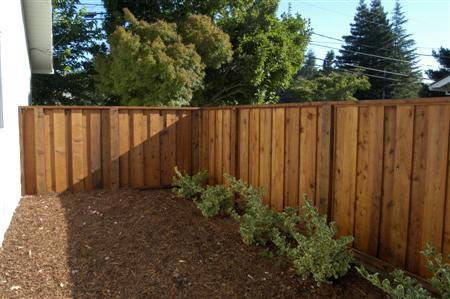
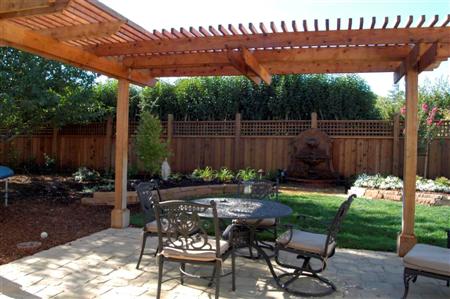

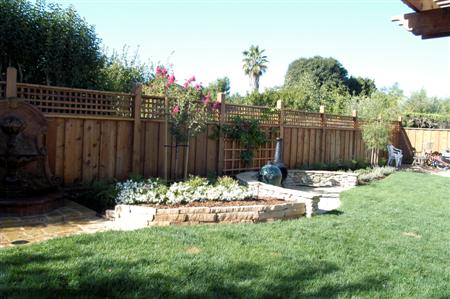
Medium project above included: Back yard only- Irrigation and drainage systems, flagstone patio, lawn (700 sq.ft.) flagstone barbecue area and seat wall, perimeter fencing for back yard, accent arbor, lighting package, small concrete utility area, and linking flagstone pathway.
Large Landscape: $75,000-$150,000
Large landscapes are usually distinguished by more detail work and accessory features of a large overall scale, usually the whole lot. Larger scale grading and infrastructure work is usually required.
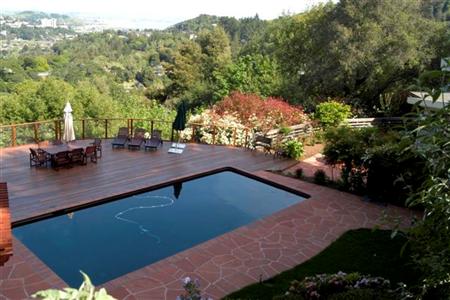
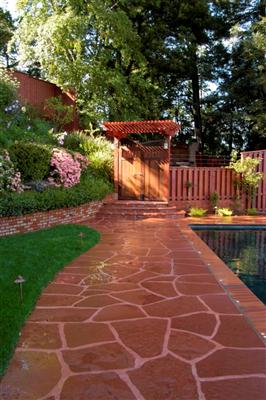
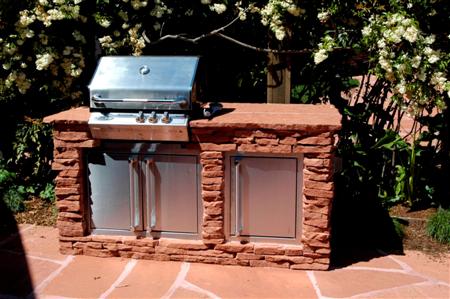
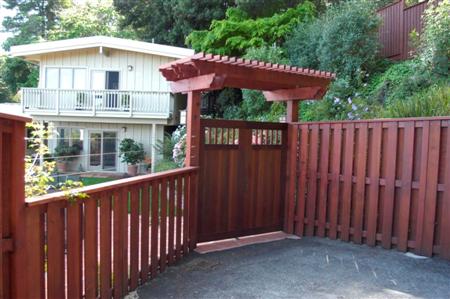
Large project above included: Irrigation and drainage systems, large flagstone patio (1000 sq.ft.), large deck retrofit, water feature, barbecue island, perimeter fencing and deck railing, entrance arbor, lighting package, front entrance gate and pillars, and linking flagstone pathway.
Custom Landscape: 150,000 and up
These custom projects are just that, custom. They tend to have a lot of handcrafted detail and more expensive materials. They also typically incorporate more elements, on a larger scale than the project cost categories above. Large scale retaining walls and grading are often required. Plantings typically are installed with larger container sizes and box trees (the cost of large box trees can equal a small scale project).
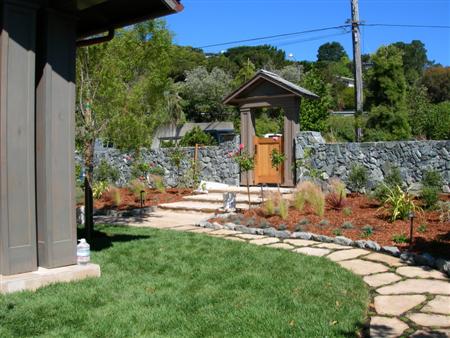
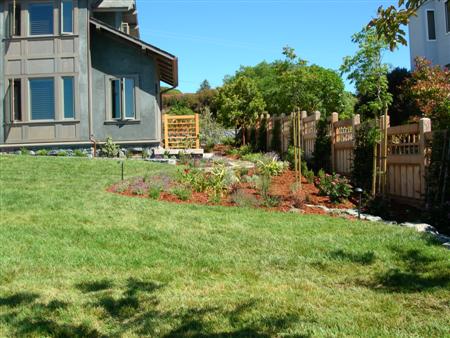
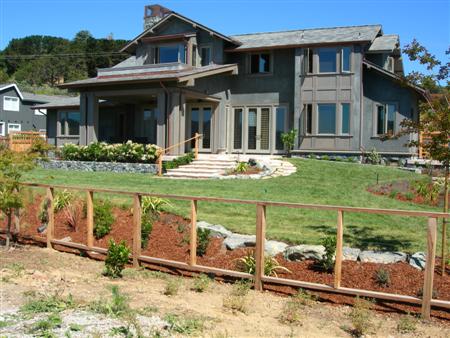
Custom project above included: Extensive retaining walls and engineered patio area, decorative stone veneer walls throughout, linking flagstone pathways for front and back yard, custom cedar fencing, gates and trellises, large stone patios, large lawn areas, several large box trees, drainage, irrigation and lighting systems, and well articulated planting beds.
I had the good fortunate to visit the Legion of Honor Museum in San Francisco on the opening weekend of the new Monet in Normandy Exhibition, a showcase of over 40 paintings for museums and collectors around the world.
Monet had a wonderful talent for capturing light and landscapes and the exhibition shows a great variety of his work from nearly 50 years of painting in the region.

Claude Monet: Grand Canal- Venice
Check out our images of Monet’s home in Giverny in our Great Gardens and Parks Portfolio.
The new De Young Museum in Golden Gate Park is a bold new addition to a park that is slowly reinventing itself. The De Young takes its place with the renovated Conservatory of Flowers and new sustainable model Academy of Sciences Building under onstruction, to make the face of the new Golden Gate Park. The De Young is the new crown jewel of the park, with its copper clad facades and controversial architectural form.
Looking at the landscape setting of the new De Young is a bit of mixed bag. Berkeley professor of Landscape Architecture Walter Hood sets the landscape as an understated collaborating piece to the architecture that is the true focus of the new museum. In some regard this is to be commended. The wild hills of poppies and ferns along the rear of the museum blend well with the feel of a wild and bohemian (under-maintained) Golden Gate Park.
Hood confirms this impression: “In a way the building [the new de Young Museum] is so loud that no matter what you do in the landscape it’s not going to be as loud as the building. At first I thought the landscape has to be its own thing, but there’s just no way it can be. It’s not large enough; it’s working at this in-between scale, in between the park and the building. How do you make this landscape an in-between space?” [Pruned Blog]
There are interesting detail elements: stained black wood mulch, chips and chunks of black stone mulch, a fence constructed of twigs and leaves. Inside the museum is an intriguing fractured bluestone entry (by Andy Goldsworthy), and a sculpture garden (with installation from light artist James Terrell) under the large cantilever of the museum that projects to the west.
Yet, somehow the grounds of the new museum do not live up to the
architecture. Part of this may be remedied with time and growth. The landscape and sculpture gardens do not have the same dynamic interaction, quality, and balance of a museum like the Getty. This is hardly a fair comparison from a monetary or spatial standpoint. Still, it seems the landscape could have been used to better effect.
The sculpture garden seems too small, plant selection in places seems to be struggling (Kafir lily, Camellia, and Ferns among others), and the landscape area and fountain to the east side are much more pleasing in plan view from the museum’s tower than they are on the ground.
In a park clearly showing its age and slowly being reborn, it will be
interesting to see how the new addition of the De Young landscape matures and ages. Will it become like Union Square- a garish collaboration of materials with little usability and durability. Or, will it mature into a graceful backdrop to the slow patina of the new museum it seeks to dress- time will tell.
For More:
-The Hybrid Spaces of Walter Hood
–Pruned Blog- “The Peacemaker”
Decomposed granite is a commonly used material for pathways. It’s fine sandy texture packs well for pathways and provides a softscape alternative to concrete or other harder surfaces.
Is Decomposed Granite (DG) the best option for pathways? It depends on the application and the amount of maintenance desired. After a recent tour of over 50 residential gardens by a variety of landscape contractors and based on comments from our customers, I have found there are places where DG works and where it does not. There are typically three types of DG installations, natural unbound, stabilizer bound, and resin bound (Polypavement or TerraPave).
Natural Untreated DG:
DG without any binding agent, which is usually compacted with a Vibraplate.
Pros: Looks good and makes great garden paths through plantings and in secondary areas, least expensive DG option.
Cons: Material movement off of paths into planting beds, migration of the material if installed on sloped pathways, moss growth in shady areas, muddiness during the wet season, tracking of the material into the house or onto patio surfaces, needs to be refreshed and maintained periodically to look its best.
Stabilized DG:
DG with a stabilizer agent to aid in binding the material together.
Pros: Less migration with stabilized material, less costly than Resin bound DG pavement.
Cons: Stabilizer is expensive, gutter runoff and rain may erode the material, has same problems, although often more minor as untreated DG as noted above.
Resin Bound DG:
DG with polymers/resin used to create an asphalt like hard surface
Pros: Solves many of the problems associated with the other two DG types
Cons: Can still erode over time, especially if not compacted with Steamroller (which is often not possible due to access or cost), expensive, texture of surface is more like asphalt and less like DG, which depending on the situation, may be less desirable.
Where should DG be used- we recommend using DG for secondary garden paths, where aesthetics are important, but a hard durable surface is not required. Another option instead of DG are compactable gravels or walkway gravels, usually 1/8” in size. Some of these have fines material and pack well like DG, others are just fine gravel, that does not pack as well, but does not migrate as much and is usually easier to maintain. Based on our experience we don’t recommend DG for areas under eves as the material gets dripped on and etched by gutters. Areas where garbage cans are going to be stored, or heavy traffic areas are better suited to concrete or stone.
For More:
Past article on DG Types
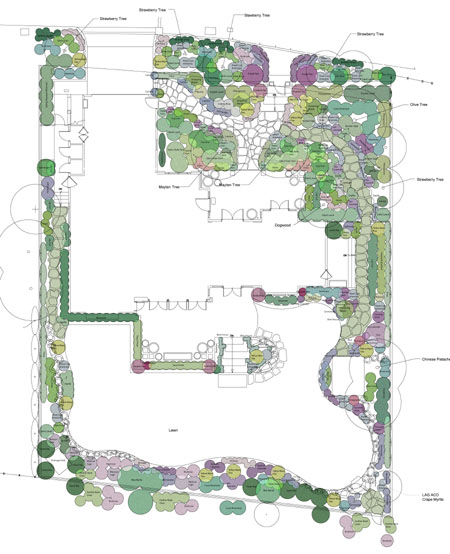
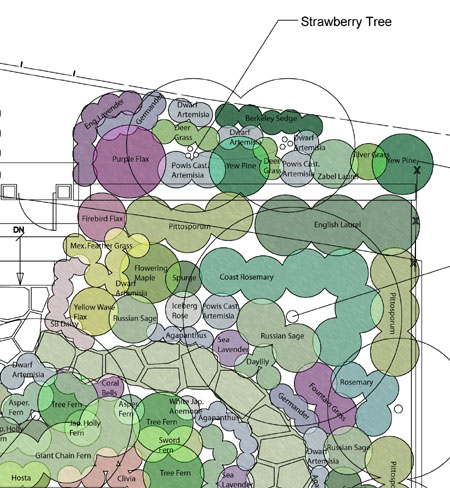
Here is a color planting plan from a recent project. We use colored planting plans with common plant names for illustrative communication with clients. Over the years we have found that these type of plans are much more effective and easier for clients to understand than black and white wireframe plans with Latin names, number systems, or abbreviations.
I got a great compliment from a customer this week, the owner of a large custom residential project we are finishing up: (to paraphrase)-“You guys are the best with service and follow-ups of anybody we deal with, and not just contractors on the house, but companies in general.” It’s not the first time we received a compliment like this, customer service is an important driving factor that distinguishes our company from others, inside the industry and out. Are we perfect, far from it, we tend to dote on projects in construction especially; but, we do try to provide responsive, personalized customer service.
This is especially an issue with contractors. I wish I could bottle this concept for perspective customers at times when I am on my third unreturned call to a painting company for a sub-contract within the span of the week. With contractors especially, there are two important criteria for assessing quality- both workmanship and service!
I try not to rant here too much, and instead try to keep things focused on
things landscape related with an occasional customer service commentary. But,
after a series of incidents with Nextel’s woeful customer service, I wrote a
series of blog articles about our experience several months back. The
interesting thing is the effect of these posts. Because they were a big hulking
corporation, with commensurately slow and hulking customer service, Nextel could
care less about our company as a customer. Maybe that’s nothing much to fault
them on there. But a quick Google of “Nextel
Problems,” puts our posting in the first page of results, along with other
Nextel dissenters. And, Nextel is the most often searched term on the blog,
which means people come here to read our experience.
Just another example of how the Internet and blogs can be a great forum for
voices, opinion and accountability. Just ask business consultant heavy weight
Tom Peters and his experience with the Boca Raton Resort
& Club: “an incredibly crappy (“die rather than go back”)
experience.”
For More:
The Nextel
Series
Off the subject of things landscape, here are some great quotes that struck a chord with me as collected by David Allen in his book Getting Things Done:
Opportunity is missed by most people because it is dressed in overalls and looks like work – Thomas Edison
Life is what happens to you while you are making other plans – John Lennon
How come little kids practice and big kids don’t? –Steve Shull
We act as though comfort and luxury were the chief requirements of life, when all we need to make us happy is something to be enthusiastic about –Charles Kingsley
In order to arrive at what you do not know, you must go by the way of ignorance – T.S. Elliot
There is no expedient to which a man will not go to avoid the real labor of thinking –Thomas Edison
The average man does not know what to do with his life. Yet wants another one which will last forever –Anatole France
To be what we are. And to become what we are capable of becoming, is the only end in life – Robert Louis Stevenson
The palest ink is clearer than the fondest memory – Chinese Saying
The mind is not a vessel to be filled but a fire to be kindled – Plutarch
Well the spammers have forced me to tighten the restrictions on comments, you must now have a Type Key account to comment- something that I would encourage if you are interested in commenting. I would rather leave commenting open, but right now we are get hit with waves of spam. It would be one thing if the spam was actually trying to sell something (as if posting here would make any impact whatsoever), but most of the time it is non-sense. I wonder what the function of this is with regular email spam as well. Why spam random and disjointed messages? Maybe its a contest to see which spammers can spam the most, or they are waiting for a reply or remove me message, so they can spam that person even more.
Here’s another look at alternative mulches, after last weeks look at recycled glass mulch. In addition to glass, there are a few other recycled materials that give a different look than bark or gravel. Recycled rubber mulch is an interesting alternative mulch. It is available either as a simulated mulch, designed to look like wood chips, or in pieces looking like ground rubber. Consumer Reports looked at the benefits and differences of rubber mulch with traditional wood mulch.
There are some questions about the long term effects of mulches made out recycled tires that contain other chemicals that may leach into the soil.
There are other alternatives out there too, like recycled screws or nut/grain hulls.
For More:
International Mulch
American Rubber Mulch