March 28, 2007
Shop Where the Pros Shop
Walking the aisles at a home improvement store last week, I noticed the marked difference between the quality of components and parts for irrigation systems and lights. While they may be cheaper, the parts aren't nearly the same quality as those we install in our landscapes.
Fortunately, the easy solution is to shop at an irrigation specialty store, such as Horizon or Ewing. Both have a comprehensive selection of irrigation, landscape and lighting equipment. They also have professional expertise to help with projects, which you won't find at a big box store. Both vendors also have great websites where you can browse and even shop online.
Posted by Michael O'Connell at 09:31 AM | Comments (0)
March 12, 2007
Matching Contribution Program Donation
A current client took advantage of our Matching Contribution Program, we donated a $500 matching contribution to the Mount Tamalpais School. The school, a non-profit independent school in Mill Valley, offers instruction for grades K-8.
Posted by Michael O'Connell at 08:50 PM | Comments (0)
February 19, 2007
Know Thy Project (Wants & Budget)
After participating in forum with local contractors and garden designers, the subject of client wants and budget planning was a key part of the discussion. As the client going into a new landscape project (and major investment of time and money), the more informed you are, the better off you are in terms of creating a successful project. A successful project is not only one where when people step into the back yard and there is a jaw drop and wow factor. A successful project is also one that is done on time and on budget, with a good contractor and/or designer, with high quality craftsmanship that delivers on your needs.
To achieve a successful landscape project there are a couple of key elements that require some thought(preferably prior to starting the process):
1- Wants: What do you want for your new landscape/garden? Do you want the English Country Garden that you have been brainstorming about with cutouts from Sunset Magazine? Do you want a utilitarian space that solves some of your yard's problems and makes the space more usable- a place to play, to barbecue, to entertain, to store? At a minimum, develop a general overview of your wants and write them down- share them with your contractor and designer.
2- Budget: How much do you want to spend? This is a tough question, you may not know anything about the cost of landscape projects. Can I get my landscape project done for $10,000, for $50,000, more? Do research in magazines, with friends and neighbors, call local contractors, relate experience from past home improvement projects.
Once these first planning steps have been accomplished now its time to put together a great team to design and build the project. Key factors are finding professionals that are going to be easy to work with, provide good service, and deliver a quality project. Interview contractors and designers through consultations to find a good fit. Nothing can sidetrack your project faster than getting a contractor who doesn't respond to phone calls, doesn't follow-up on promises and doesn't perform quality work.
Next Steps: Read our past articles on budget and selecting a contractor-
"How Much Does it Cost- Budget and Landscape Projects"
"Hiring a Contractor- The 1st Meeting"
Posted by Michael O'Connell at 07:19 PM | Comments (0)
December 23, 2006
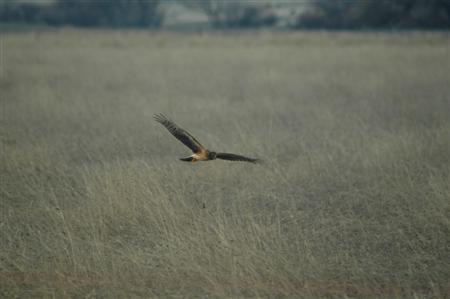
Hawk Hunting
From somewhere other than work... Happy holidays, merry Christmas, Hanukkah and a great 2007!
Posted by Michael O'Connell at 08:26 PM | Comments (0)
December 13, 2006
Winter Time is Drainage Time
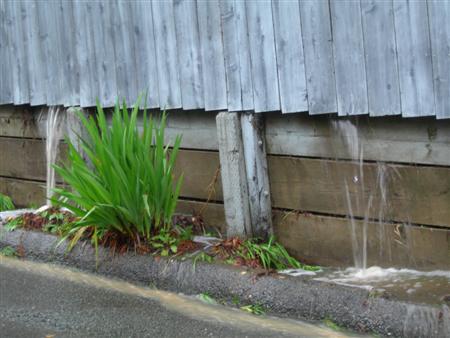
Driving from a hillside project this morning, I snapped the the photo below- water pouring over a wood retaining wall. This time of year, scenes like this underscore the importance of good drainage. The solution in this situation, a gravel drainage field and perforated pipe would absorb this surface water and solve the problem. It is possible that this is being caused by existing drainage lines, but it would be a better solution if they didn't daylight over the wall.
Posted by Michael O'Connell at 01:12 PM | Comments (0)
December 08, 2006
Common Landscape Mistakes: Fences
A continuing entry in our Common Landscape Mistakes series:
Fences are a fairly basic element in landscape construction, but one where we see common mistakes in design and construction. Here is a guide to fence types and ways to avoid common mistakes.
Proper construction of fencing really depends on the type of fence being installed.
The basic fence types are as follows:
1 -Perimeter Fence- metal, wood or wood and wire. Typically constructed for privacy on back or side yards. Heights typically 4-6’
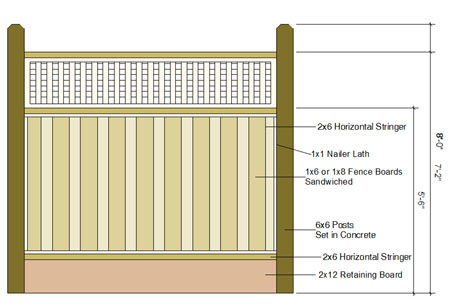
8' Fence with Lattice
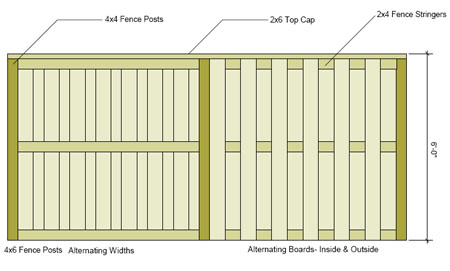
Examples of Standard 6' Fence and Alternating Board "Good Neighbor Fence"
2 -Front Fence- Typically a picket style, or semi-transparent design, heights typically to 3-4’
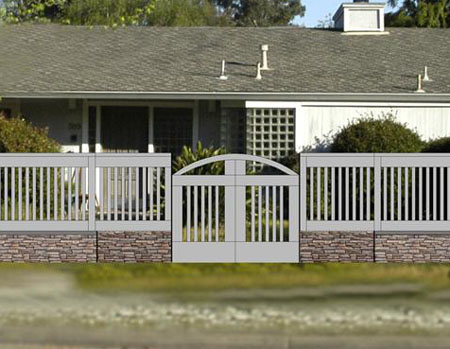
Mock-up of vertical picket fence on top of wall
3-Deer Fence- to restrict deer access, typically wood and wire, or wire and Metal T-post construction, heights typically 4-6’
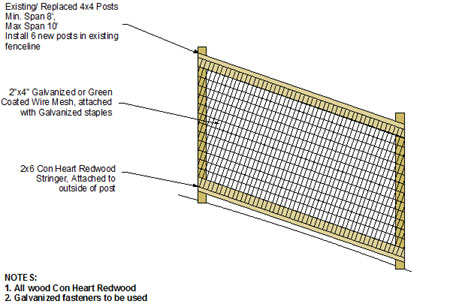
Wood and Wire Deer Fence on Sloped Terrain
4-Railing: Typically wood, tensioned cable, or prefabricated metal. Heights typically to 3’
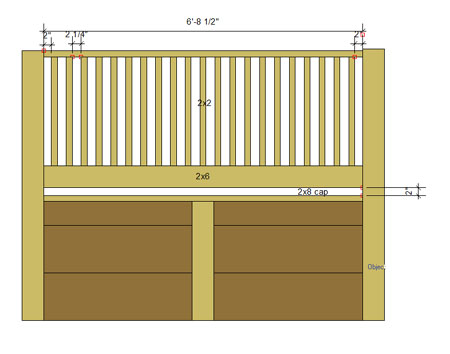
Wood Railing on Top of Retaining Wall
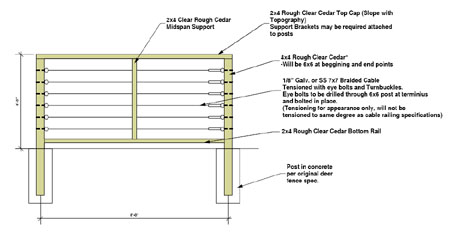
Cable Railing with Wood Frame
Construction: Fences are composed of a few key elements-
-Posts: typically set in concrete
-Stringers: Horizontal boards connecting posts
-Fill: Fence Boards, wire mesh, tensioned wire, etc.
-Decorative elements: Wood lattice, extended trellises, kicker boards, decorative detailing
Biggest Mistakes:
Here a few of the most common fence construction mistakes we see:
1-Horizontal Stringers: 2x4 boards are the most common stringers used in fencing. These boards typically span posts, spaced 8’ on center. Because wood at this span will have a tendency to sag, it is important that the strongest orientation of the board is used- in this case the 4” side, not the 2” side. Horizontally oriented 2x4 stringers spaced at 8’ spacing will show a noticeable bow over time.
-Insufficient stringers- we prefer 3 stringers for some styles of fence, especially over 6’. There are some fence designs where 2 stringers are insufficient.
2- Poor Posts:If the style will allow, pressure treated posts can be used to help resist weathering. In cases of finished fencing, a decay resistant wood such as redwood or cedar should be used. Untreated wood used outside will weather and decay rapidly. Post should be set in concrete, typically 9-12” in diameter and at a typical minimum of 18” in depth, with gravel installed at the base of the base pier to allow water to escape. Posts poorly set, will result in a structurally unstable fence, that will likely lean, or blow over in a storm.
3- Ugly Styling: Some fences are just downright ugly. Take a look in your neighborhood to find fences that have a good style of construction and a good aesthetic.
4- Poor fastening: screws or nails can be used for fastening the fence depending on application. Nails and screws should be galvanized at a minimum to prevent excessive rust and weathering; on high quality fencing stainless steel screws or nails should be used.
5-Too tall: Fences over 6’ need special construction considerations- 4x4 posts are typically not strong enough, 4x6 or 6x6 posts should be used. Sufficient stringers should be used on tall fences, 1” thick fence boards should not exceed a 5-6’ span vertically between stringers, if they do, they are likely to warp. Check also with your local building department, frequently fences over 6’ require permitting (sometimes 2’ of wood trellis is allowed, totaling 8’)
Posted by Michael O'Connell at 08:33 PM | Comments (0)
November 29, 2006
Our 2007 Calendar
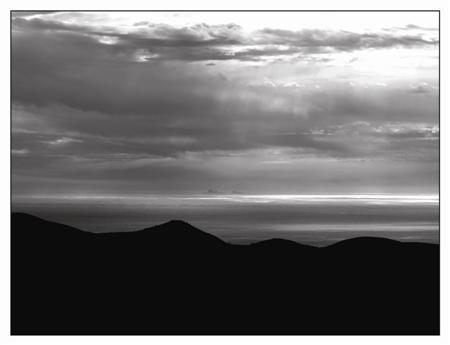
Our 2007 Calendars, Everything in Black & White, will be mailing out soon. This year's calendar features, well, black and white photography. If you would like a free copy of the calendar please send us an email with your name and address.
Enjoy a great holiday season!
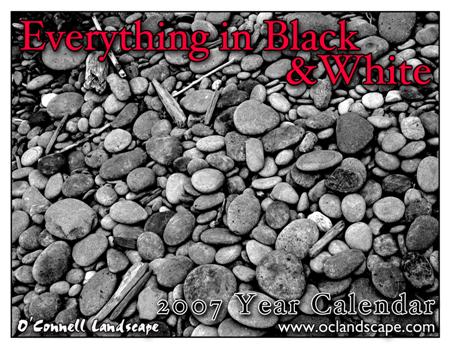
This Year's Cover
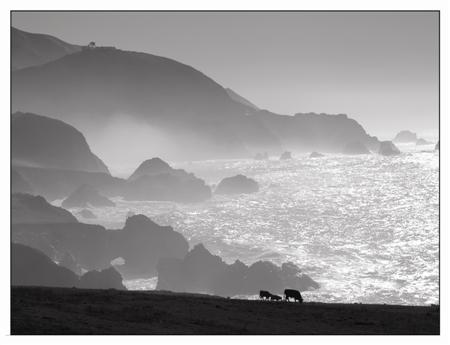
Some of the monthly images
Posted by Michael O'Connell at 09:29 AM | Comments (0)
November 28, 2006
Common Mistakes: Don't Paint that Concrete!
A continuing entry in our Common Landscape Mistakes series:
It might seem like a good idea, but painting concrete rarely turns out well. From time to time I see concrete walkways or driveways that have been painted over. Painting can make an old outdoor concrete surface look new for a while, but the drawbacks are numerous. Painted concrete chips and fades considerably, almost guaranteeing that in a couple of years that nice consistent looking surface is going to be faded, stained, and flaking. Painting concrete also usually reduces the roughness of the surface, making it more likely someone will slip on the smooth surface when wet. In addition to these draw backs, because it's not done very often, painted concrete often looks strange in the landscape. Unless an earth-tone is selected, the color often stands looking strange in the context of the neighborhood.
Alternatives to painting are replacing the existing concrete with new colored concrete. Or, if the concrete is in good shape, there are specialized concrete stains available that can add color while not flaking or reducing traction on the material.
For More:
Article on Acid Concrete Staining
Scofield- Stains, Dust-on and Integral Concrete Colors
Posted by Michael O'Connell at 02:43 PM | Comments (0)
November 10, 2006
It's Masonry!
Here is a bit of a humorous note for a Friday- one of my little irritations (excuse me while I get on my soapbox) is the mispronunciation of the word masonry.
Masonry being defined as: work constructed by a mason, esp. stonework: the crumbling masonry of ancient walls.
I frequently hear subcontractors and other contractors refer to the craft of the noble mason as "masonary", which unless they are using some sort of masonry mercenaries is incorrect- it's masonry!
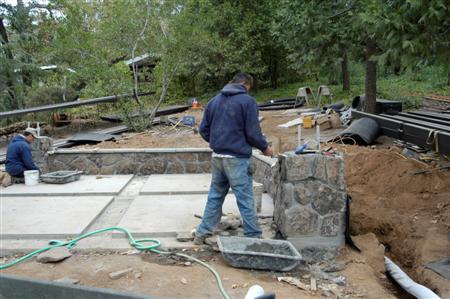
Some of our "Masonaries" on a current project
Posted by Michael O'Connell at 10:23 AM | Comments (0)
November 07, 2006
Common Landscape Mistakes
In posts this week we are going to focus on some common detailing mistakes made by homeowners and professionals alike in residential landscaping. Some of these are little things, some are major errors, but all are good things to be aware of when working on landscape projects.
Common Landscape Mistake: Overplanting
This is a common problem we see in residential landscape projects, planting too densely or not realizing the mature size of plantings being installed. To a certain degree this can be stylistic and subjective, some people prefer dense plantings, but at times it can look downright comical. Often wanting things to look good right away, plants are planted too close for their mature sizes. Also, frequently shrubs are planted too close together. For example an Angel's Trumpet is planted 2.5' away from a Butterfly Bush, both of which can grow to 6'x6' in size. The most important thing is to remember to balance the immediate impact of plantings with their more mature look in 2-3 years.
Frequent plant spacings (on center)
1-2' Small flowering perennials and annuals
2-3' Woody shrublets, small shrubs, most grasses
4-6' Larger shrubs, hedging shrubs, large grasses
8-12' Small scale trees, aggressive vines, aerial and regular hedging shrubs
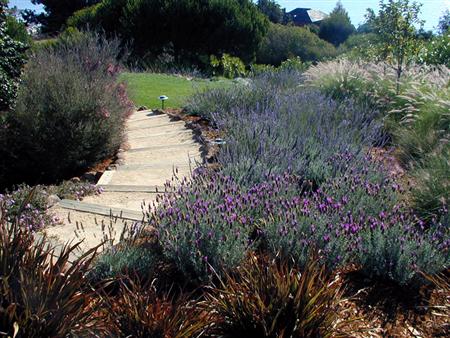
Dense plantings aren't always a problem- with these Lavender and grasses, tighter groups are desirable for distinct massings.
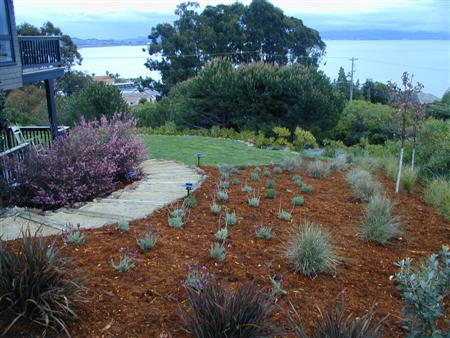
Notice the same planting about 18 months before, when the plantings had first gone in. The Lavender here is planted between 2-3' apart, but just coming out of the container the planting still looks insignificant.
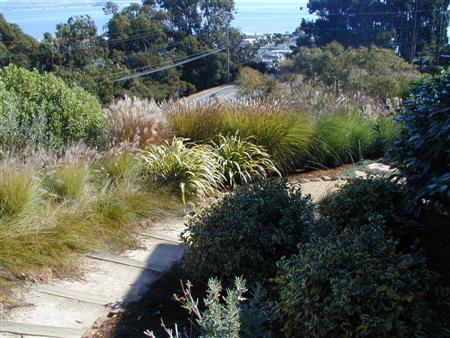
These ornamental grasses and New Zealand Flaxes are another example of density used properly. Problems can arise when larger shrubs with courser texture are planted in the same way.
Posted by Michael O'Connell at 01:12 PM | Comments (0)
October 24, 2006
The Green Wall of Mongolia
There was a fascinating article in the Wall Street Journal (subscription required) today about efforts in Mongolia to fight sand storms in the Gobi Desert that are progressively becoming worse (expanding goat herds and global warming being two main culprits). The storms frequently blanket Beijing with sand and dust, with material and haze ending up as far afield as Utah.
The solution, a $150 million dollar project to plant Alders, Junipers and other hardy plants (temperatures range in the Gobi from -40 degrees F to 110) in a huge windbreak across the country to help control the storms and dust. Experts are skeptical whether the endeavor will be successful, but Mongolians are hopeful the vegetation project will make a difference in controlling the storms.
Like any vegetation project, the difficulty lies in getting the trees and shrubs to establish and be maintained over the long term. In a couple of decades we may be referring to a second Asian wonder, the "Green Wall of Mongolia."
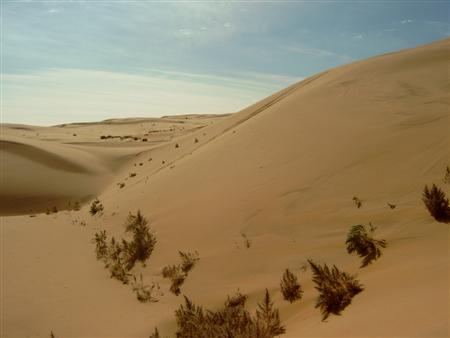
Image from Wikipedia

Posted by Michael O'Connell at 11:47 AM | Comments (0)
October 11, 2006
The Mundane Is Important
Working in conjunction with a general contractor on an aspect of a construction project produced the following revision to a concrete paving pattern. The revision was different than an earlier conceptual scheme for the walkway in some small alignment details. While the builder commented that the adjustments could be made in the field, my experience has always been that clarity and specificity on paper save headaches later on.
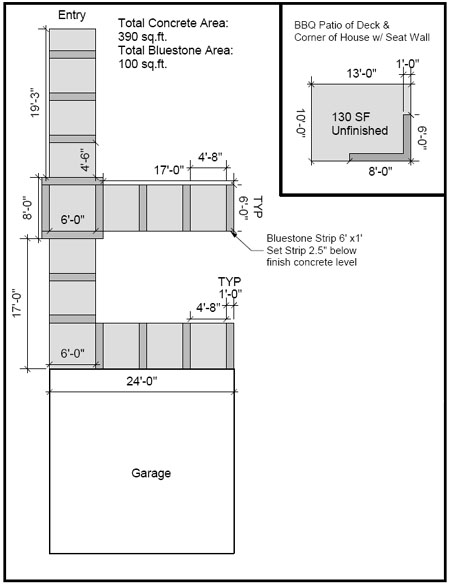
To quote the architect Le Corbusier- God is in the details.
Posted by Michael O'Connell at 11:43 AM | Comments (0)
October 10, 2006
Low Voltage Lighting Systems and Energy Requirements
The State of California put into effect new energy regulations, Title 24, that regulate energy usage of light fixtures installed in commercial and residential settings. One point of confusion is the application of the new law, which went into effect last October, on low voltage landscape lighting systems.
Exterior lights mounted on buildings have a variety of new restrictions regarding fixture energy efficiency, photocells, and motion detection equipment. Fortunately, these new restrictions don't apply to landscape lighting systems. To quote the California Title 24 Residential Compliance Manual,
"Example 6-15
Question
My House has a row of small incandescent bollards along the walk way to the front door. Do these have to be high efficacy?
Answer
No. The high efficacy requirement only applies to lighting mounted to the building.
Example 6-16
Question
I would like to install low-voltage landscape lighting in my yard. Are these required to be on a motion sensor and photocontrol?
Answer
No. Even though low-voltage lighting does not qualify as high efficacy lighting, lighting not attached to a building, like landscape lighting, is exempt from this requirement."
These exemptions make sense, because landscape lighting is in a completely different class of application and energy use than other residential and commercial lighting.
Posted by Michael O'Connell at 07:18 PM | Comments (0)
October 09, 2006
Fall Is In The Air
There definitely is a feeling of fall in the air here in Northern California. People often lament a lack of seasons here in California, but they are still here, if a bit more subtle. The days are growing shorter, our Indian summer October weather is here today, and of course the trees are turning. Striking specimens this time of year are Chinese Pistache and Liquid Ambar; two trees that dependably color this time of year.
It is always amusing when planting people's yards how they are drawn to plants in season. In the fall people want to plant Crape Myrtles and Japanese Maples, in the spring its Flowering Cherry and other blooming fruit trees. Most trees that have this seasonal interest do go deciduous and drop their leaves- thus emerging or departing all the more spectacularly.
Posted by Michael O'Connell at 03:43 PM | Comments (0)
October 04, 2006
Remembering the Rain
With a feeling of fall in the air and showers descending on the North Bay this morning, we are jolted back to the reality of working in the rainy half of the year. All things considered, California's Mediterranean climate affords an amazing opportunity to work year round. This is without threats of snow or freezing temperatures endured by most of the rest of the country. Still, working in the summer has the benefit of not staring at 10 day forecasts or satellite and doppler radar each morning.
Working in wet weather will typically slow the pace of landscape projects, but most items can be continued on in the rain; with notable exceptions being large excavation in heavy rain and finished concrete. The other benefit of the onset of fall is being able to start to turn down sprinkler systems from the summer watering schedule.
For More:
"Dealing with Rain in Landscape Projects"
Weather.com - 10 Day Forecast (San Rafael), Western Satellite/Doppler
Posted by Michael O'Connell at 09:25 AM | Comments (0)
September 26, 2006
Finding Plants for Native Restorations
While our company focuses mainly on residential design and installation, we do from time to time branch out on a commercial or specialty project. A recurring problem on one such restoration project, which occurs when working on native plant revegetation is finding the specified plantings. We have been working on an estimate for a landscape restoration of a creek channel in Marin. The plants specified for the revegetation of the creek banks are California natives, which are not grown in the mainstream nursery trade and only grown by native plant specialty nurseries. The problem that restorations provide are two fold- the plants themselves are not commonly grown and not widely available, and the numbers required to revegitate a restoration site (several hundred for a quarter acre of creek bank in this case) are typically not readily available.
An interesting example of this was a native grower who was contacted by a developer for a revegetation project. Frequently there will be a planning requirement that mandates revegetation with plants native to the site on large developments in California that displace existing vegetation. The builder contacted the grower with his list of several hundred native plants that were specifically endemic to the site, with a time table of 6 months for installation. The grower responded with frustration and amusement because none of the plants were available in the trade and had to be propagated and grown from seed or cutting. This process that can take several years depending on the size of plant required.
Posted by Michael O'Connell at 12:27 PM | Comments (0)
September 22, 2006
Soil Disposal Can Be Costly
There was an interesting piece in the San Francisco Chronicle about soil disposal in Atherton. The city council established a fee of $22 per cubic yard to dispose of soil to offset the cost of wear and tear on roads from large trucks hauling soil. After a voracious outcry from residents they removed the fee. For large basement projects the fees could add up to tens of thousands of dollars.
One would assume that this fee was on top of the cost imposed by the disposal service or dump. Here in Marin disposal fees can run $35-50 per yard for soil debris bins delivered to a project site. At the local dumps the fees are less, $15-30 per yard, assuming the material being disposed is clean fill soil. Using Marin's prices as a guide, the Atherton fees would have amounted to a 50-100% additional cost. An average residential landscaping project can generate anywhere from 10-200 cubic yards of soil material if large retaining walls or terraces are involved that require extensive excavation.
Posted by Michael O'Connell at 10:49 AM | Comments (0)
August 14, 2006
Newly Updated Portfolio
Our project portfolio is newly updated with current featured projects. Each feature includes a project description, design schematics and details on project installation in construction. The regular work examples galleries have also been updated to reflect our most current work.
Featured Projects:
Kent Woodlands: Entrance Gate, large deck around swimming pool, and flagstone entry
Larkspur: Terraced stucco walls and mediterranean plantings
San Rafael: Outdoor kitchen, space reclaiming retaining wall, and bluestone patio
Tiburon: Landscape with new home construction, plantings, large lawn and fencing
Sonoma: New entrance with flagstone approach and multi-tiered deck, newly articulated entertaining spaces and pool remodel
Posted by Michael O'Connell at 08:45 PM | Comments (0)
August 08, 2006
Blog References Around the World
In looking at some other blog pages that link to our blog, it is amazing to see the global reach of the internet and blogs. Two interesting links to note- one came from a site in the UK, Real Oasis, referencing our post about Current Cutting Technology on the peninsula. The other item of interest, a reference to our post on glass mulch from Portugal. I was surprised how easy it was to the read Portuguese posting (as a Spanish speaker it read like misspelled Spanish).
Posted by Michael O'Connell at 04:01 PM | Comments (0)
August 07, 2006
Turned Earth Turns 200!
200 Blog posts in just over a year! Thanks to all our readers, next stop 300...
Posted by Michael O'Connell at 03:59 PM | Comments (0)
July 26, 2006
New Developments- No Topsoil
There was an interesting feature in a recent issue of Landscape Architecture Magazine, describing how plants and trees in new developments don't grow very well. The culprit- the construction process. Typically, when new homes are built, the builder scrapes the site clean of topsoil during cleaning and grading. Even if new soil is added to the site later, it often does not replicate the endemic soil. Often in new developments, especially in our area, the housing isn't build on the greatest soil to begin with (the California Central Valley, doesn't have this problem, but that raises a whole slate of other issues).
Add to the soil factor the fact that builders typically don't do a great job installing shrubs and trees for new houses, and the problem is compounded further. Still sometimes trees do grow well. In one new development where we are currently working, there are some beautiful Sycamore trees that are about 5 years old and 25-30' tall. This issue underscores the fact of the importance of soil preparation when installing plantings, especially in new developments.
Posted by Michael O'Connell at 05:24 PM | Comments (0)
July 14, 2006
Summer Weather & Better Irrigation Controllers
There was an article in the Marin IJ yesterday on the amount of water used by lawns in the summer months. This is going to become more and more of an issue as building continues in California, and water supplies are tight. Alternatives to lawns range from synthetic turf, to alternative lawns, or low water use plantings.
One aspect that struck me was the amount water districts are paying local schools to replace natural turf with synthetic- $15,000 per acre. That is $.35 per square foot, which wouldn't begin to pay for the sand underneath the new synthetic turf, let alone the cost of all the materials and installation. It is a small step in the right direction though. School fields tend to be difficult and poorly maintained. Those schools with synthetic turf such as Marin Academy, which was one of the first high schools in Marin to install synthetic turf, look pretty realistic aesthetically.
There are a host of new technologies on the market which aim at water conservation. Smarter controllers are one way to improve water use. WeatherTrak Controllers, produced by Hydropoint, a local company out of Petaluma, use innovative weather tracking systems, to monitor and adjust watering. With a subscription service, data is downloaded to the controller and adjustments to the watering schedule are made automatically. These new controllers are the wave of the future, as water districts are starting to clamp down on water use and make mandatory these new technologies.

Controller Image from the WeatherTrak Website
For More:
Past blog posts on- Synthetic Greens & Lawns, Alternative Lawns
Posted by Michael O'Connell at 05:23 PM | Comments (0)
July 11, 2006
When it Needs to Last
I was out in the field today looking at an institutional project that had heavy usage and a low maintenance budget. In these types of situations it can be difficult to establish a successful installation. For planting projects the design and selection of plants and irrigation system are of critical importance in high traffic areas (parking lots, apartment buildings, public areas, residences with active dogs or children come to mind).
Selection of plants is critical; what we typically call Cast Iron plants. These plants establish quickly and take little water or maintenance, such as: Junipers, Agapanthus, Escallonia, Dietes, Photinea, Ivy, Day Lilies, Society Garlic- plants that are frequently used in commercial and dense residential settings.
Irrigation is also critical- it must combine both automation and durability to be as low maintenance as possible. Above ground drip systems are often not as suited to these applications because of traffic over them, and follow-up maintenance required.
For projects where little or no maintenance is to be performed, it is always good to have these elements in mind going into the planning and implementation of the project. Most plantings fail because they are not designed to withstand the environment where they are installed and they do not receive the maintenance and care required to flourish.
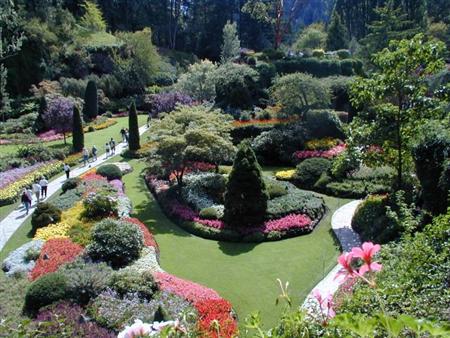
Anticpated maintenance schedule is a key factor to keep in mind for both residential and commercial projects. Want a garden like the Butchart Gardens? Be prepared to garden on the weekends or pay for a good professional maintenance service (not just mow, blow, and go)
Posted by Michael O'Connell at 02:14 PM | Comments (0)
June 08, 2006
Some Great Quotes to Stir the Blood
Off the subject of things landscape, here are some great quotes that struck a chord with me as collected by David Allen in his book Getting Things Done:
Opportunity is missed by most people because it is dressed in overalls and looks like work – Thomas Edison
Life is what happens to you while you are making other plans – John Lennon
How come little kids practice and big kids don’t? –Steve Shull
We act as though comfort and luxury were the chief requirements of life, when all we need to make us happy is something to be enthusiastic about –Charles Kingsley
In order to arrive at what you do not know, you must go by the way of ignorance – T.S. Elliot
There is no expedient to which a man will not go to avoid the real labor of thinking –Thomas Edison
The average man does not know what to do with his life. Yet wants another one which will last forever –Anatole France
To be what we are. And to become what we are capable of becoming, is the only end in life – Robert Louis Stevenson
The palest ink is clearer than the fondest memory – Chinese Saying
The mind is not a vessel to be filled but a fire to be kindled - Plutarch
Posted by Michael O'Connell at 07:37 PM | Comments (0)
June 07, 2006
Clamping Down on Comments
Well the spammers have forced me to tighten the restrictions on comments, you must now have a Type Key account to comment- something that I would encourage if you are interested in commenting. I would rather leave commenting open, but right now we are get hit with waves of spam. It would be one thing if the spam was actually trying to sell something (as if posting here would make any impact whatsoever), but most of the time it is non-sense. I wonder what the function of this is with regular email spam as well. Why spam random and disjointed messages? Maybe its a contest to see which spammers can spam the most, or they are waiting for a reply or remove me message, so they can spam that person even more.
Posted by Michael O'Connell at 06:28 PM | Comments (0)
May 25, 2006
New Client Section Coming Soon
We are working on development of a password protected client section to our website that will provide greater information and resources for our current and former customers. More to come in the weeks ahead!
Posted by Michael O'Connell at 01:54 PM | Comments (0)
May 17, 2006
A Calender Correction
It looks like there was a misprint of the first edition calenders that we sent out at the beginning of the year to clients and friends. If you were one of those who are confusedly seeing January in July, you can print and paste a corrected version (download .pdf). Our apologies for the misprint and confusion.
Posted by Michael O'Connell at 07:34 PM | Comments (0)
May 12, 2006
More Examples of our Blog

We seem to be finding our way into several postings on Business Blog anaylsis, such as Mike Sansome's, Converstations- Changing how business talk to their customers.
In the case of the post he is referring to, the blog is a great tool for posting serial information like construction progress photos.
Posted by Michael O'Connell at 07:32 PM | Comments (0)
May 11, 2006
Green Driveways?
GardenDesignOnline had an interesting post on Green driveways with a link to an article from the New York Times. The featured architects, Greenmeadow Architects, in the story are right in our neck of the woods.
As for our take on Green Driveways, they are, of course, more maintenance intensive. The technique they show in the article is better than using the traditional turf paver blocks, where the grass tends to die out over time. Newer styles of turf paving block claim to have helped reduce this problem. There are links in the NYT article to manufacturers. Alternatives include permeable pavements such as Polypavement, Decomposed Granite with natural resin binding agents.
Posted by Michael O'Connell at 06:13 PM | Comments (0)
May 02, 2006
Turn on the Sprinklers
With sunny skies returning to California, and temperatures in the 80's, it is time to turn the sprinklers on. Here are a few tips:
1- Check the settings on your controller- It have been a while since they were adjusted. Drip stations should generally have 20 minutes - 1 hour of scheduled watering time a week, divided in 2-4 weekly waterings. This of course depends on the location, solar exposure, plant types, and type of irrigation system that was installed. Once the thermostat starts to climb into the 90's, increase the frequency and reduce the duration of watering. Soft stemmed plants or plants in pots may even need two waterings to keep from wilting in high temperatures.
Lawns should receive 30 minutes to an hour per week, again depending on conditions and temperature. More frequent waterings 4-6 times per week are typically required in the warm season.
2- Check your sprinklers: Run through the stations of your controller to check for problems. For lawns, check head coverage and distribution. Heads may have rotated out of alignment, or nozzles may have become clogged. For drip systems, turn on the station and listen for leaks, look for wet spots, or squirting water from drip lines. Where plants have grown over the lines listening may be the best way to find leaks. After the air has escaped the lines, listen for the sounds of escaping water. Check the emitters of plants that look dry.
3- Not sure how much to water? Probe the soil- The soil should be moist but not wet. Brush back mulch around emitters to see the amount of water plants are getting from drip systems. If you want a better way to check moisture content, purchase a soil probe from your local garden center.
Check the posting "Scheduling your Controller in Warm Weather" for more watering tips.
Posted by Michael O'Connell at 11:16 AM | Comments (0)
May 01, 2006
A Review of Our Blog

Our blog was recently reviewed by Brian Brown's Pajama Market, a blog dedicated to reviews of Small Business blogs.
The review is an interesting critique. For the most part it is favorable of the type of material we post here. With regards to subject matter, he has his critiques, such as my series on biking commuters.
Part of the intriguing nature of landscape architecture as a whole is that it covers a diverse range of topics. From a residential landscape construction perspective, Brian is right, biking to work is not pertinent. From a landscape architecture perspective, urban planning issues and alternative transportation are very relevant.
Our blog is meant to focus on subjects relating to our industry, but there is only some much fodder here for a regular running commentary. We also try to post information that is related in art & design, and items that are of interest to our community. In addition, as Brian notes, the blog is meant to be a more personal and varied look at the goings-on of our company, rather than a formalized newsletter approach. As far as his critique, my only critical reaction is that he could have looked at more of our past postings over the last 10 months, instead of justthe last few weeks. There are some very good posts that have both content and scholarship, rather than just pure content aggregation and links.
Posted by Michael O'Connell at 11:57 AM | Comments (2)
April 17, 2006
An End to the Rain
Well it looks like we finally have a break from the rain, at least for this week. So far year to date here are the precipitation numbers from the National Weather Service (as reported from the Civic Center in San Rafael):
Jan: 4.97
Feb: 2.74
Mar 11.41
Apr: 8.40
This totals 27.5 inches of rain to date, last year we had half this amount (14 inches).
Last year was also a wet year with rain into June:
Jan: 0.00
Feb: 5.02
Mar: 7.22
Apr: 2.07
May: 3.35
Jun: 0.53
Hopefully we do not have a repeat of last year's May. All of this precipitation affects our landscape projects, resulting in muddy conditions and slowed time tables.
For More:
Find rain data from the County of Marin Website
Posted by Michael O'Connell at 08:02 PM | Comments (0)
April 11, 2006
More on Biking Commuters
Here is a follow up to my post last week concerning biking to work and commuting bikers. I wrote an email inquiry to the Marin Bicycle Coalition, who were very responsive in answering:
"It depends which roads you are talking about. The County of Marin doesn’t do “bike counts” to assess the number of people cycling. So if it’s county roads (such as sections of Alameda del Prado or Atherton) then the data doesn’t exist. Yet. However, that will change when the Non-Motorized Pilot Program starts. The County will have to do before and after bike counts, though it’s worth noting that they will probably only do counts on streets relevant to the bike projects being built at a part of that program."
So as part of the new funding for the pilot programs counts will happen in effected areas. I found from MBC, some data from the US Census Bureau, which confirms my suspicion, virtually nobody (nationally .4%) bikes to work. This may be why the county doesn't count bikers currently.
Biking has actually gone down quite a bit over time, as well as alternative means of transportation to work.
In 1960:
10% Walked to work
12% Took public transportation
64% Drove to Work
By 1990
4% Walked to work (down 60%)
5.3% Took public transportation (down 56%)
86% Drove to Work (up 35%)
-73% of those who drove, drove alone
Means of Transportation to Work for the U.S.: 1990 Census [I couldn't find 2000 information]
|Means of Transportation to Work | Number Percent |
|Workers 16 years and over.......... | 115,070,274 100.0 |
| Car, truck, or van............... | 99,592,932 86.5 |
| Drove alone.................... | 84,215,298 73.2 |
| Carpooled...................... | 15,377,634 13.4 |
| Public transportation............ | 6,069,589 5.3 |
| Bus or trolley bus............. | 3,445,000 3.0 |
| Streetcar or trolley car....... | 78,130 0.1 |
| Subway or elevated............. | 1,755,476 1.5 |
| Railroad....................... | 574,052 0.5 |
| Ferryboat 1/................... | 37,497 0.0 |
| Taxicab........................ | 179,434 0.2 |
| Motorcycle....................... | 237,404 0.2 |
| Bicycle.......................... | 466,856 0.4 |
| Walked only...................... | 4,488,886 3.9 |
| Other means...................... | 808,582 0.7 |
| Worked at home................... | 3,406,025 3.0 |
1/ This category was included in "Other means" prior to 1990.
Posted by Michael O'Connell at 03:09 PM | Comments (0)
April 06, 2006
When It's All about Price
I stumbled up a great post on a Gardenweb forum by a garden center owner. A young couple asked him why his plants cost $25, when Home Depot only charged $10. He explained in his posting that he was lucky to make 7% on his $25, but rather than explain rising gas, water, and overhead cost, he simply replied that if cost was their only consideration you should shop at Home Depot (garden center employees could be working in the lumber department in the winter and often have little plant knowledge).
Pricing is often a sensitive subject with clients. But, if consumers think that their local garden center (hardware store, etc.) can compete with one of the worlds largest corporations on a price basis, they have little or no understanding of the realities of the marketplace.
Why does a beer at a restaurant cost $4 when you could go to the supermarket and buy a six pack for $7? Because, you are paying for an experience of being in a full service restaurant, not just the beer.
We aren't the cheapest in our market segment either, but we sell more than landscaping, we sell a process and customer service along with our product. We tell potential clients the same thing as the nursery owner, if price is your only consideration, we are not going to be the right fit for your needs.
Posted by Michael O'Connell at 09:34 AM | Comments (0)
April 05, 2006
Compliments from the Mail Bag
Below is an email I received from a reader of our blog & website. I always enjoy emails like this one!
In the afternoon, we logged on to your website ... and I must say that both my husband and I were SO impressed with your website. It is just amazing!
The photos are absolutely wonderful (and we learned that you took all of them as well -- more compliments!), and the articles, information, and links are so helpful. As I have studied the Japanese Tea Ceremony and appreciate all things Japanese, I particularly enjoyed the wonderful photos of the Japanese gardens. Beautifully done!
We have marked your site as a "favorite" and will certainly return again and again. An extraordinary job!
Posted by Michael O'Connell at 06:24 PM | Comments (0)
April 04, 2006
Commuting Bikers?
I have been riding my bicycle from home to work this week. It is about a 10 mile ride each way from San Rafael to Novato. A few things struck me. First, and this is true of walking as well, biking through a neighborhood gives a completely different perspective than driving. From a landscape perspective this means being able to look at the front yard landscapings (or lack of them of) for the residences along route. It also is a much more sensory experience, a true feeling of distance as it relates to human scale. On Monday the sensory experience was profound as I was drenched from head to toe.
The other curiosity was the lack of bikers on the road. Marin is touted as one of the strongest areas in the country for bicycle activism, such as the Marin Bicycle Coalition, who helped bring home a lot of cash in the latest transportation bill for bike path pilot programs. Marin also has a significant history in the evolution of mountain biking. So why then is it that there are not more bikers commuting on the road? Sure, there are hoards of weekend warriors in west Marin, around the skirt of Mt. Tam, and in China Camp, but where are they during the week?
Maybe this is something that is more prevalent in southern Marin, but in the north part of the county, I don't see very many bikers. We certainly can't hold a candle to Holland, where bicycling is a means of transport primarily, rather than a recreational pursuit.
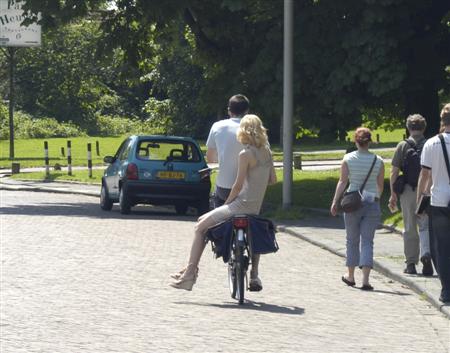
When was the last time you saw a scene like this in Marin?
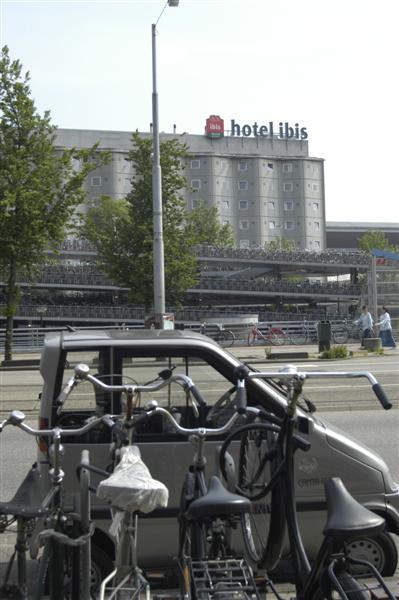
Bikes and a very small car in Amsterdam. The structure in the background is bike parking with 10's of thousands of bikes
For More:
Southern Marin Bike Route Map from MBC
Northern Marin Bike Route Map from MBC
Marin IJ Article on new bike paths
Posted by Michael O'Connell at 01:57 PM | Comments (0)
March 30, 2006
Turned Earth Turns 150!
9+ months and still going strong! Thanks to those readers who browse and comment from time to time.
Posted by Michael O'Connell at 07:50 PM | Comments (0)
March 29, 2006
Shaking Like It's 1906
There was an interesting article today in the Marin IJ with links to simulations done by the USGS, trying to replicate the type of movement that occurred in the famous 1906 San Francisco Earthquake. The amount of violent shaking of the Golden Gate's span that was created in the simulation was amazing (deformations are amplified 100x in the simulations), and potentially horrifying. One wonders if cars on the span during a seismic event like this would be flung into the bay waters below. It brings to mind the famous destruction of the Tacoma Narrows Bridge, although that was a case of wind resonance.
After the experiences and disaster reporting that took place after Hurricane Katrina, it is scary to think about a potential repeat of a great earthquake like 1906.
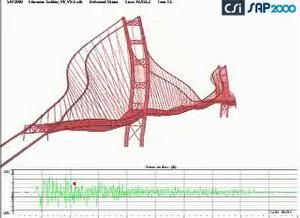
Image from Marin IJ: Computers and Structures, Inc/via USGS

USGS Photograph of SF City Hall after the quake- from Wikipedia

For More:
- USGS page with all sorts of Models and Videos of Earthquake simulations
Posted by Michael O'Connell at 06:18 PM | Comments (0)
March 17, 2006
Views of Ireland
Enjoy some of my favorite photographs of Ireland- Happy St. Paddy's
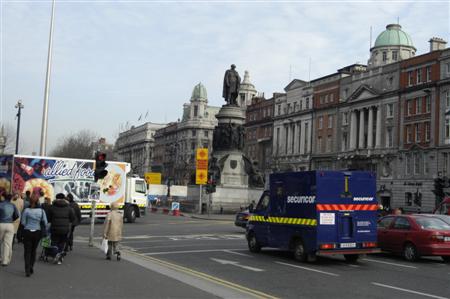
O'Connell Street in Dublin with our famous namesake lawyer and Irish patriot Daniel O'Connell
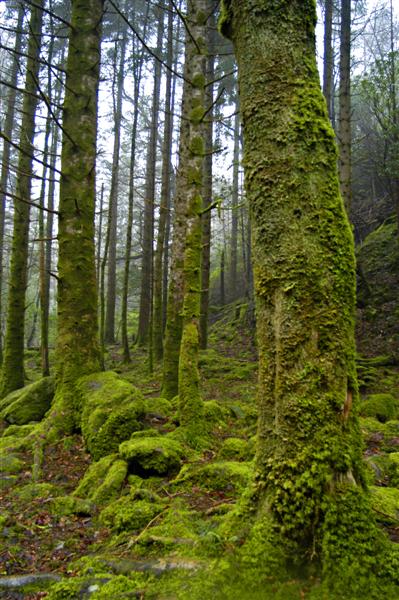
Moss Covered Trees in Glendalough monastic site, County Wicklow
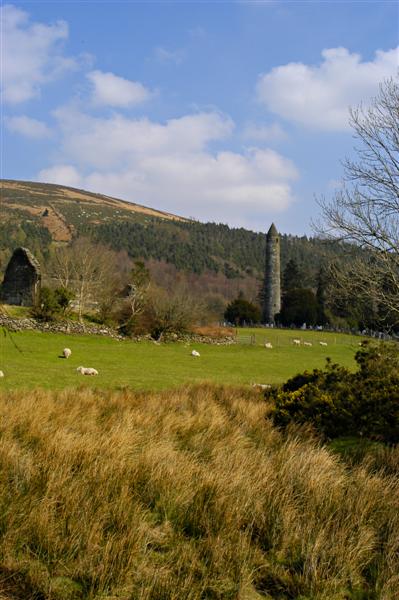
Ancient Stone Round Tower- Glendalough monastic site, County Wicklow
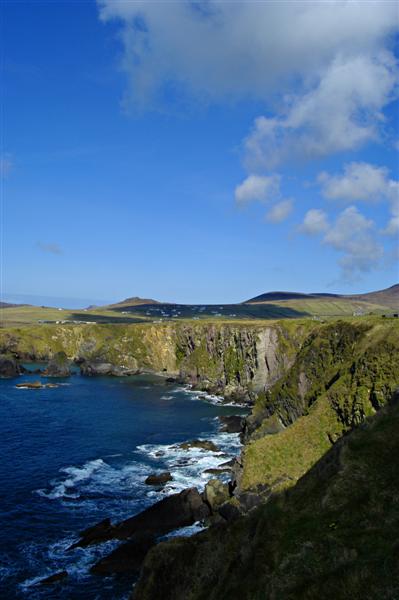
The Beautifully Rugged Dingle Peninsula on Ireland's west coast
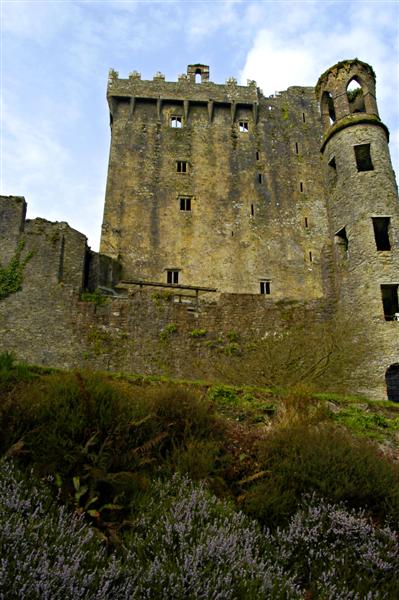
Moss Covered Facade of Blarney Castle, home of the famous stone
Posted by Michael O'Connell at 10:05 PM | Comments (0)
March 16, 2006
March & Spring
Spring is approaching, with continued rain and cold temperatures in Northern California. One thing that will warm the hearts of college basketball fans is the return of the NCAA tournament. One great tool for those trying to follow the tournament and something that is no doubt reducing productivity nationwide is CBS streaming video free of games from the first rounds. Definitely worth a look.
Posted by Michael O'Connell at 10:23 PM | Comments (0)
March 14, 2006
Articles from Marin Magazine
There were a couple of interesting articles in Marin Magazine recently, the newly launched magazine last year that profiles places and people within the county. The first profiled and asked questions of architect Sim Van Der Ryn, who I had a recent post on concerning a radio appearance and recent book.
The second gave a history and overview of Marin County open space.
Both are worth a look, and the magazine posts its current and archive content online, allowing for easy access.
Posted by Michael O'Connell at 06:30 PM | Comments (0)
March 03, 2006
Going Paperless
We are big advocates of digital technology, as can be evidenced by past postings. One element where we are trying to reduce paper work and storage requirements is to go paperless. Using primarily Adobe .pdf format we are in the process of archiving many of our old documents and records into digital form. It makes records searchable from our company network and saves on filing space. Going paperless or the "paperless office," is not a new or radical notion by any means. Companies such as Xerox or Adobe (and countless others) have been pushing products and services for years. But as costs for good optical scanners and printers continues to go down, and acceptance increases among clients, vendors and our industry in general, it makes going paperless even easier and more seamless. We send our estimates out to clients in Acrobat format and use it for most client correspondence, which means decreased turn around time and easy tracking and search of documents.
Now to make sure everything is backed up!
Posted by Michael O'Connell at 11:30 AM | Comments (0)
February 24, 2006
About Our Blog- What & Why?
To our Readers,
Sometimes when reading a blog, if it is a site that you have never visited before, the question becomes what is this blog/site all about?
Part of this is due to the novelty and recent emergence of blogs. Jumping into the daily entries of a blog can be confusing at times. Turned Earth is an informational blog created by O'Connell Landscape, a design-build landscape contractor located in Marin County, California.
We maintain a blog for a few reasons. First, it allows for the dissemination of some great information for both prospective clients, and a wider web audience in general. You will find here a wide range of articles including information on our current projects and company news, information on landscape/garden materials, good links to online resources, local garden events and more.
Hopefully this information is useful in itself, and for clients in our area who are looking start a landscape project, hopefully it lets you know a little bit more about the company, design interests, our projects, services, and expertise.
So please, browse around, we try to post new information regularly (3-5x per week). Our main site also contains some good information, including our Great Gardens & Parks portfolios from around the world. Feel free to comment (it lets us know people are reading!) and feel free to ask questions to get more information.
Regards,
Michael O'Connell
O'Connell Landscape
Posted by Michael O'Connell at 04:37 PM | Comments (0)
February 03, 2006
Your Landscape Should Have an Owner's Manual Too
Over the years we have developed a landscape care booklet for our customers to accompany our finished projects. Proper care of newly installed landscapes cannot be under-emphasized. The booklet defines the plant and lawn care, watering procedures and special care requirements of elements installed (like wood fence staining, lighting or fountain pump maintenance).
An important point to remember is that a beautiful garden is an investment of both money and time (the home gardener's or the paid gardening service). Continued care will be required to make the garden thrive and look its best and protect and enhance the initial installation investment. Over time plants may need to be added or removed, mulch refreshed, perennial plants replaced with age. The underlying systems of the garden must also be maintained and repaired from time to time (drainage, sprinklers, lighting, etc.).
While this requires continued thought and effort, it is part of the charm and captivation of the garden. It is a living entity that like all living things does better with love and care.

Posted by Michael O'Connell at 06:34 PM | Comments (0)
January 16, 2006
Fertilizing Lawns
A proper fertilization schedule is important for a thriving green lawn. Fortunately, the good folks at Scotts have good products and information available to guide gardeners through the best types, timing, and techniques for lawn fertilization.
In addition to the articles and product information, they also provide an Annual Fertilization Program Builder, best suited geographically by region. This guide recommends products and the best times to apply them for your particular type of lawn grass.
Also see Scotts general gardening information

Posted by Michael O'Connell at 08:49 PM | Comments (0)
January 12, 2006
Great Spanish Language Resource
Working in an industry with a large number of Hispanic workers, good Spanish language resources are important tools to communicate effectively. For example, the newer versions of Microsoft Word include a translation feature, which will translate items directly in word into Spanish.
Another great resource is the online dictionary WordReference.com. Often it is difficult to find compound forms of words in standard dictionaries. Word Reference provides translations based on differences in Spanish dialect and compound word forms.
An example would be that a car is coche, but a cable car is teleférico
Posted by Michael O'Connell at 12:41 PM | Comments (0)
January 05, 2006
It's Photography- Art League of Northern California Exposition
Opening this weekend on Saturday evening is the Art League of Northern California's open photography exposition, "It's Photography." This expo was open to entries and one of my photographs will be in the show. From what I have seen so far, there are some very beautiful pieces, so it is definitely worth a visit.

Visit the show to see the piece entered. This related piece from Barcelona comes from the same set of photographs
Posted by Michael O'Connell at 07:01 AM | Comments (0)
January 03, 2006
Drainage for Residential Properties
This recent round of storms hammering Northern California underscores the importance of having a good drainage system to remove water from your property and keep your yard and house dry. Here are a few important points when considering a residential drainage system.
1- Connect house downspouts to drainage system
The water from your roof can cause the most problems if not properly drained away from the house foundation. Often the need for sump pumps can be eliminated simply by connecting all the downspouts and draining them away from the house.
2- Determine the best type of drain for each application
Surface drains work well in hardscape installations where water can be graded to collect in a point, or in softscape areas where there are fixed points of standing water. French drains work best in areas where there is sheeting or subsurface water, or where there is not a easy location to collect water in a surface drain. A french drain is a burried line of perforated pipe in a gravel field, which collects and transports water.
3- Use the right pipe
Flexible black corrugated pipe is best used in situations with French drains when it is surrounded by gravel drainage field, and when it is covered by protective drainage fabric, or a fabric mesh sock that is placed over the pipe. Corrugated pipe does not work as well for transporting water underground over distances. The corrugations trap silt, sediment and debris which can clog up over time. PVC Drain pipe is a better choice. Its smooth interior helps water flow without backups.
4- Where does the water go?
Drainage usually flows down hill, with common outlets being either day lit through to a curb and gutter, out into a back hillside, or in a gravel dispersion field underground, where it can percolate into the soil. The objective is to get water out of sensitive areas where it will damage the house or accumulate in the landscape.
Posted by Michael O'Connell at 04:41 AM | Comments (0)
December 23, 2005
Merry Christmas Landscape Architects
I have a Christmas gift request for all our landscape architects friends out there from all the contractors that construct your projects.
Would it be so hard to just include a quick quantity take-off on your plans?
Two clicks and you could give us the square footage of that 5000 square foot lawn with enough organic bezier curves to make Pierre Bézier himself crazy (the inventor of a type of adjustable curves for computer drafting). As a stocking stuffer could I request that detail sheets with your plans proceed in some logical order and be adequately labeled.
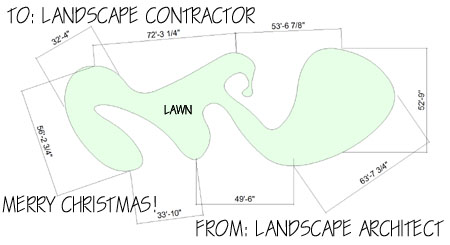
Happy Holidays from O'Connell Landscape!
Posted by Michael O'Connell at 06:02 PM | Comments (0)
December 14, 2005
New Downloads of Featured Projects & More
We have posted downloadable profiles of several of our landscape projects in our new Downloads section. Projects are outlined with examples of garden styles and budgets which can help prospective clients get a better feel for our projects. Also, because all of the files are in an easy to read and print Adobe Acrobat file they make great reference material. As we expand this new feature you will be able to download videos of installations, audio pod-casts, and other materials and portfolio literature.
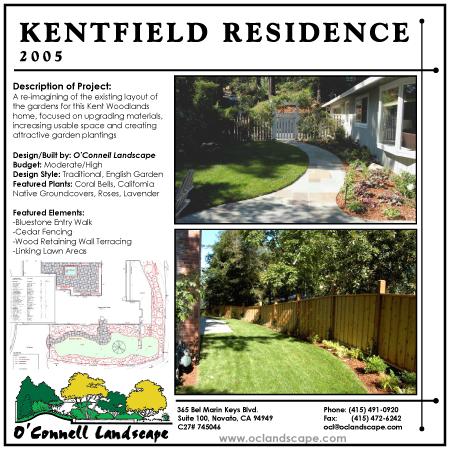
Example of a Featured Project Cut Sheet
Posted by Michael O'Connell at 09:30 PM | Comments (0)
December 06, 2005
Turned Earth Turns 100!
I am happy to post our 100th entry on Turned Earth. We started the blog in June and since then we have posted 100 entries in approximately 170 days. Thanks to everyone who reads the blog, and we hope to continue to provide a good garden resource for those seek general information on the internet, as well as an enlightening source of information for clients and prospective clients.
Posted by Michael O'Connell at 05:58 PM | Comments (0)
December 04, 2005
A Wild Turkey Follow-Up
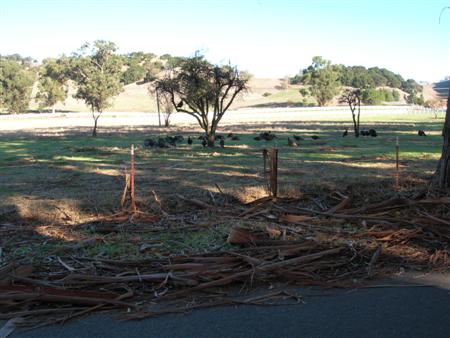
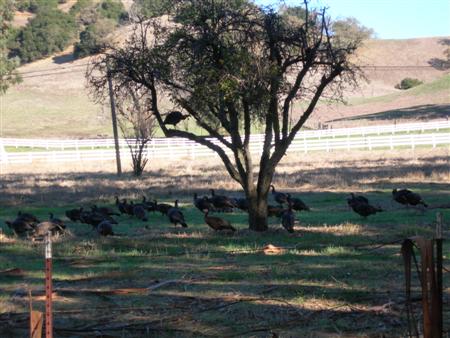
To follow up on my Thanksgiving related entries (Happy Thanksgiving I & II) concerning Wild Turkeys, here is some visual proof from some open space in San Rafael. By my count this flock numbers over 35 birds. Perhaps soon our #1 concern will be Turkey resistant landscapes instead of deer resistant ones!
Posted by Michael O'Connell at 08:26 PM | Comments (0)
December 02, 2005
Digital Basemaps
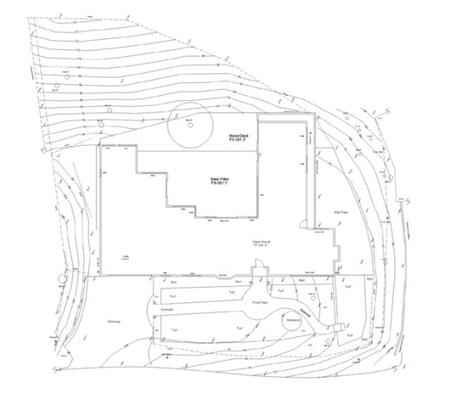
Continuing on the technological theme from yesterday's post, another innovation that has made planning easier, less costly, and more accurate are digitally surveyed basemaps for landscape plans. We use a basemap creation service, a firm that specializes in providing elevation and base information for golf courses and landscape projects. Instead of measuring existing features such as fence lines, house footprints, etc. with a tape measure, the site is digitally surveyed using state of the art digital surveying tools and GPS equipment. A series of points are taken and then translated into a computerized drawing that pinpoints the location of existing features and elevation changes.
What this means is a product that is more accurate, less time consuming to create and much easier to use and manipulate throughout the design process. We are able to have the accuracy of a traditional surveyor, but at a fraction of the cost.
For more information on having a digital basemap created in the Marin or Sonoma County area check out MapMaking Systems, the firm out of Sonoma County that creates our basemaps.
Posted by Michael O'Connell at 07:16 AM | Comments (1)
December 01, 2005
The Photographic Revolution
I received an advertisement from Nikon today touting the company's new D200 Digital SLR Camera. Targeted at everyday photo enthusiasts, this ten megapixel camera retails for $1,700. The way computers, cameras and memory storage devices have advanced is amazing. Our first digital camera for job site photography was a Casio that wouldn't take a clear image unless it was on a tripod and probably had less than a megapixels in resolution.
Also amazing are the cards that go into modern cameras, the size of a postage stamp and over 1gb in size are amazing considering the technological capabilities of 10-15 years ago. Our early Packard Bell 386 Windows 3.0 Machine boasted a robust 40mb of internal memory. We upgraded that machine with a 100mb memory board (the size of a foot-long sub).
All this exponential storage and quality improvement means that today's youngsters will probably barely know a film camera. And, their digital cameras will take better quality photographs than the best 35mm consumer film cameras of a generation ago!
Posted by Michael O'Connell at 01:05 PM | Comments (0)
November 24, 2005
Happy Thanksgiving II
I am up in Northern California for this Thanksgiving. Reading the San Francisco Chronicle this morning on my BlackBerry, which is what I am posting from, I noticed another article about Wild Turkeys, which now number over 250,000 in the state.
Posted by Michael O'Connell at 09:22 AM | Comments (0)
November 23, 2005
Happy Thanksgiving
Turkeys, Thanksgiving's most recognizable symbol, can be seen frequently in the open space and neighborhoods of Marin. These wild turkeys were introduced in waves beginning in the late 1800's for hunting. The wild birds are actually natives of Texas, and it seems lately they can been seen throughout the county. According to an article last year in the SF Chronicle the turkey population is on the rise, especially in the North Bay.
This means in addition to a turkey on your table there may be one in the back yard and on your car out front (male turkeys especially like their reflections)
Happy Thanksgiving!
Posted by Michael O'Connell at 06:53 AM | Comments (0)
November 18, 2005
Clients in All Shapes and Sizes
One of the enjoyable things about designing and building gardens for customers is getting to work with all sorts of interesting clients. From lawyers and venture capitalists to school teachers and airline pilots, the personal interaction with our clients is one of the great aspects of this work. We get to meet all sorts of interesting people from any number of professions while working throughout beautiful Marin and Sonoma counties. Often people are making substantial investments in their properties, creating living areas, gardens, reclaiming space or doing a major remodeling job. But the refreshing thing about it is taking the existing property and transforming it to meet a mutual vision. It is something that clients can get excited about, and it makes the process fun.
Posted by Michael O'Connell at 11:55 AM | Comments (0)
November 08, 2005
Hills and Views
One of the given aspects about working in Marin and Sonoma counties is it seems that no property (save a scarce few) are on flat ground. Hillsides of all sorts present access and equipment challenges and can make large scale design elements difficult. Fairfax, Mill Valley, Tiburon and other southern Marin communities tend to be the worst offenders. But the tradeoff is some stunning views of those very hills that can make our work so challenging and interesting.
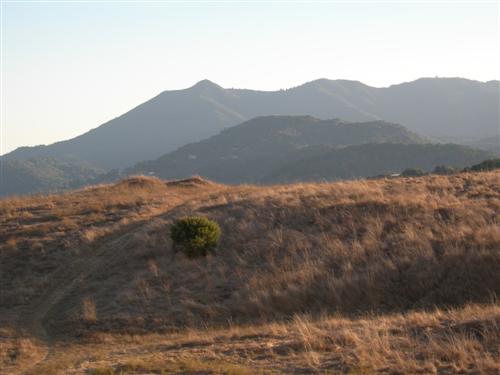
Mt. Tam Viewed from the North
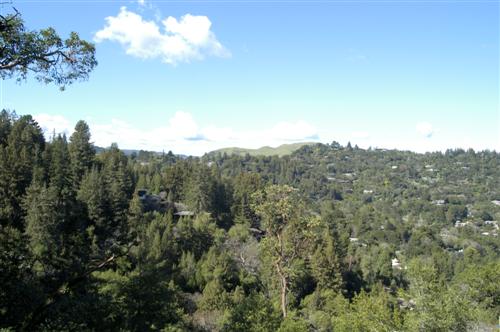
The Wooded Ross Valley
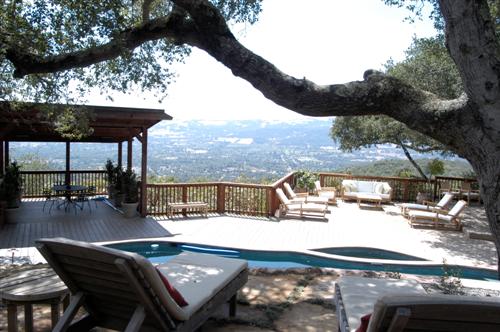
The Sonoma Valley
Posted by Michael O'Connell at 12:53 PM | Comments (0)
November 04, 2005
Spam + Blog = Splog?
It looks like my problem, mentioned earlier this week is not unique. There is an article in today's Washington Post about the rising trend of spamming of blogs. Just another result of the wild west feel of the internet.
On the Good Side of the Internet
As may be evident from reading my posts, I am a huge fan of the online free encyclopedia, Wikipedia. For those people who are unfamiliar with the site, Wikipedia is an online collaborative project where people post encyclopedia articles in a huge information sharing project. I am consistently amazed on the quality and authoritativeness of the information. Here is the power of the technology of the internet, to contrast with the spamming problem mentioned above. It seems like I find new sections of the site everyday, and it can be great for finding information on plants or other garden related information (see for example the term Espalier)
Posted by Michael O'Connell at 04:53 AM | Comments (0)
November 01, 2005
This is the Internet After All
Checking the Blog this morning there were a series of Trackback pings (for those unfamiliar with Trackbacks, a link from another blog or website posted by someone that is in reference or interest to a post). Funny I thought, haven't received anything like this before. Upon further examination the trackbacks were, let's just say, not for wholesome family entertainment. Spam isn't limited to just email.
Posted by Michael O'Connell at 06:20 AM | Comments (0)
October 24, 2005
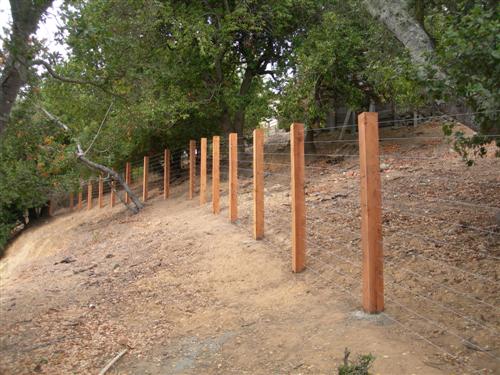
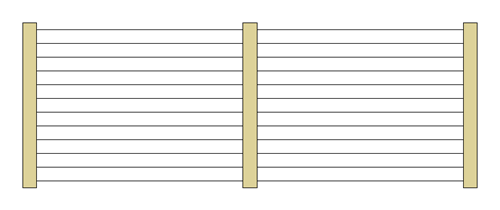
From the Drawing Board to the Real World II
Here is a second follow-up to our post on wire fencing, this time concerning a 6' wire perimeter fence that was custom designed in lieu of a chain link fence.
This type of fence provides a nice architectural feel, has some transparency, and does not draw the same amount of attention as a chain link or solid fence.
Posted by Michael O'Connell at 06:21 PM | Comments (0)
October 19, 2005
A New Toy
We just purchased a new digital camera for our office- the Nikon 7900. I have a Nikon Digital SLR (D-100), but we wanted something that could be slipped in my pocket for day to day site visits. I am sure photos from the 7900 will be appearing here and on the site real soon.
I bought the D-100 a couple of years back, when professional type digital cameras were just becoming reasonable. Now of course technology has advanced, and my old camera is outpixeled, although pixels alone do not determine image quality. Much of that has to do with the quality of the glass in front of the camera. The old Nikon has been a great camera and I have easily shot 30,000 plus images with it (including 10,000 in Europe, which can be see in our Great Gardens and Parks section)
More on the Nikon 7900:
Digital Photography Report
Cnet
PC Magazine
Nikon
Posted by Michael O'Connell at 05:41 PM | Comments (0)
October 18, 2005
The Power of Adobe Acrobat Professional
Adobe Acrobat is commonly used for creating documents distributed off the web, and for a host of other uses. A couple of years back we traded in our Acrobat Reader, for a version of Adobe Acrobat professional. At the time I was unconvinced that the switch would be worth it. We already had a utility from another program that could print documents to .pdf. The ability to create, assemble and add advanced features has definitely been worth while.
With advanced features of the new Acrobat pro you can imbed various types of data, embed audio commentaries that can be played while viewing, and a host of other features. It has made Acrobat a staple of our digital workflow and email correspondence.
I especially like the slideshow feature. By changing the view to full screen you can flip through a .pdf document just like using PowerPoint.
For More:
Hardware Zone article on Acrobat 7
Adobe
Posted by Michael O'Connell at 06:29 AM | Comments (0)
October 10, 2005
Great California Weather
I am back in the office this week after spending part of last week attending the wedding of a friend in Lincoln, Nebraska. We are fortunate in California, not only for our notorious good weather, but also for the wide range of plants that are available. In a large part of the country, where cold winters and snow are prevalent, as was the case with Lincoln, landscapes consist of large lawns and a few shrubs.
Now we certainly have similar landscapes utilizing large lawns and border plantings in California, but we also have a wide range of options in ornamental plants that thrive in this climate. We do pay a price for this however great weather and location however. You won't find may town homes selling in the low $100,000's or nice homes selling in the $200,000's.
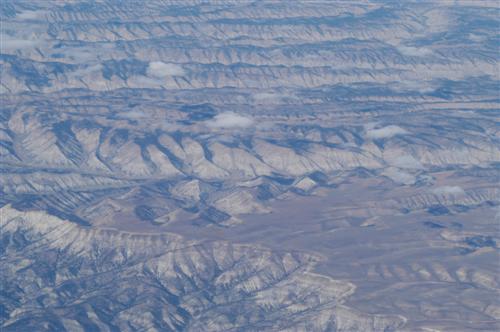
An Arid Western View
Posted by Michael O'Connell at 03:55 PM | Comments (0)
October 03, 2005
Reflections on Blogging
As we approach 70 entries and over 3 months in our landscape blog, I pause to reflect a bit on blogging in general.
Our concept behind having a blog for O'Connell Landscape, was to give a living aspect to our site. Something that would be continually updated and that would let clients and potential customers see "behind the scenes." Now this blog differs from some other blogs, in that, we typically don't do blow by blows of what is happening in the company. Rather, we try to post items that would be of interest concerning gardening, materials, landscape architecture, the occasional rant, etc. This allows anyone a good general reference, and hopefully allows potential customers to see a bit of our background and expertise.
Hopefully, we have been successful to some degree in our initial goals. We have had some good feedback from clients that have seen the blog, and from strangers that may find us via Google or other means. The blog is work, typically it takes between 30 minutes to an hour per post depending on the content. But, it is an enjoyable activity, and gives some diversity to the information available on our website.
From the Comments Section
I received an interesting comment from a visitor last week concerning some errors in word usage in one of our posts. Comments are always much appreciated, as it gives us feedback for the site. In my defense, in the last 30 days we have posted on the site close to 10,000 words amounting to approximately 40 pages of text and images, and I am sure there were more than those 2 errors to be found. Should the commenter wish to take on a pro-bono editorship in Turned Earth, I am sure we could keep him busy.
On a Whole Other Level
For those wanting to see blogging taken to an art form, check business author Tom Peter's blog/website. The staff there really put out a richness of information, that makes this serial seem paltry by comparison.
Posted by Michael O'Connell at 10:18 PM | Comments (0)
September 27, 2005
KQED Perspectives Archive
Here is the final post in a follow up to the blog piece that was aired on KQED public radio. You can find the archived version here, enjoy!
Posted by Michael O'Connell at 09:02 PM | Comments (0)
September 19, 2005
KQED Perspectives
Here is a follow up to my first post, as to when the blog piece "Tales of a Wireless World" will air on KQED public radio. It will be aired this Thursday, September 22 @ 6:07 & 7:37am. For those of you who are not near a radio, but will like to hear the piece you will be able to find it in the KQED archives.
Enjoy!
Posted by Michael O'Connell at 09:55 PM | Comments (0)
September 12, 2005
Digital Drafting vs. Hand Drafting
As it seems everything becomes digitized and done on computers it is interesting to reflect on the role of computer aided design (CAD) in landscape design. Interestingly, many garden designers and landscape architects still draw their plans by hand, especially at a residential scale. Hand drawings have the benefit of a traditional drawn look that works well for residential design. Most major design firms, in the design professions use AutoCAD or some alternative program to draft, (we use Vectorworks) especially for large scale projects.
We prefer computer drafted plans for a number of reasons. First, we typically have our sites digital surveyed with GPS technology. This ensures an accurate basemap and topographic information that can help in project planning.
The other major advantage to digital drawings is their flexibility. Revisions can be made simply without erasing or redrawing plans. We typically color our plans with digital illustration tools that give our plans a more hand drawn and colored look. Often we will include color photographs on plans that can be difficult to incorporate with hand drawn full size materials.
Digital tools are also constantly improving. Digital drawing tablets and ever improving technology mean the gap between digital and hand rendered graphics is closing.
Posted by Michael O'Connell at 06:49 PM | Comments (3)
August 25, 2005
Blog Piece to be Aired on KQED Radio Perspectives
I am happy to announce that the blog entry, "Tales of a Wireless World," will be featured as a 2 minute read perspective for KQED public radio, our local San Francisco NPR affiliate. I always enjoy the Perspectives series driving around listening to the radio on the way to work, and fortunately this piece was accepted. For those unfamiliar with Perspectives, it is KQED radio's "opinion page," featuring listener perspectives and commentary.
I go in to record the piece in the studio next week and will post a follow-up as to an airtime and its location in the KQED archives.
Posted by Michael O'Connell at 10:34 PM | Comments (0)
August 24, 2005
School's Back & Traffic is Bad
I was driving down Highway 101 last week, the central artery through Marin County on the way to San Francisco, and something was wrong. It was 8:30 in the morning and the traffic was more reminiscent of 8:30 pm. This all changed however with many schools starting this week. Now traffic is back to its typical ugliness.
Not that bad traffic is unusual for the Bay Area. According to one report, the Bay Area had the second worst traffic congestion in the nation after Los Angeles. The Marin 101 corridor is typically one of the worse traffic spots in the area in yearly traffic assessments.
Maybe the new Transportation Bill will help, as Marin landed quite a few improvement projects including the widening of the Novato narrows.
The bad traffic might have been eased a bit if back in the 60's Marin had been connected to BART. Unfortunately, a ridership that was too small, and concerns about attaching BART to the Golden Gate Bridge prevented Marin's connection to the system. This was compounded by fears that connection to BART would spur development in the area. Now, of course, any connection to BART would cost hundreds of millions per mile of line (Just witness the SFO airport extension with a price tag of 1.5 billion for just under 8.8 miles).
Until new projects get under way, or more public transit is added (such as light rail from Sonoma County), we'll have to wait for the next school vacation for easy morning commutes.
For more on traffic visit the Marin Congestion Management Agency
Posted by Michael O'Connell at 05:57 PM | Comments (0)
August 17, 2005
Tales of a Wireless World
I have been fighting long hours with our company's wireless network for a new office space, and finally I gave up on the prospect. After about $1,000 in hardware, and too many hours on the phone with technical support, we are going back to a wired network. Hopefully with the new wireless standard that is being developed, the remaining kinks will be worked out of wireless hardware.
It is amazing how the technology is advancing and becoming commonplace, which reminds me of an amazing story a colleague recently told me-
She was in a downtown area with her laptop, trying to catch up on some projects for work, and feeling like getting out of the house. She was working, undisturbed, when an itinerant gentleman passed by. His appearance was disheveled; he was dirty and verbally rambling, scabs covering his face. She focused on her work and ignored him, minding her own business as she inclined the laptop towards her a bit more. For a time the man stopped his monologue and all was silent. It was at this moment when clearly and concisely the man pointed out,
"I bet you could get wireless access from those apartments up there," as he gestured to the surrounding buildings.
My colleague, a bit surprised, clicked on her wireless network on the laptop. Within seconds, she was connected with broadband speed to a surrounding network. Amazement and a bit of incredulity set in as she contemplated the man.
It was at this moment that the reality of our new wireless, technologically inclined culture hit. The man asked if he could check his email! My colleague, a young woman, prudently told the man that the connection had not been successful and he eventually went on his way.
With this, I contemplate whether I should have, instead of calling technical support, gone downtown in search of such a man. Maybe the dot-com recovery for the Bay Area has not been as good as imagined.
Posted by Michael O'Connell at 04:25 PM | Comments (0)
August 14, 2005
Wireless Networking
We are in the process of hooking up a wireless network for our new office space and it has been quite an adventure. We are generally tech savvy, but there have been quite a few conflicts with hardware/software and details to configure on our Linksys hardware.
I have spent good chunks of the last few days talking with Linksys tech representatives in India and the Philippines. It is amazing to think of the global reach of technology and telecommunications. The Linksys support has been good as far as these things go. No wait times and knowledgeable support staff; the products, however, have not been plug-n-play.
Posted by Michael O'Connell at 11:06 PM | Comments (0)
August 05, 2005
Office Move
We are in the process of moving our office to a new location in Novato. Pictures and more info to come, once we finish moving in.
Posted by Michael O'Connell at 09:14 AM | Comments (0)
July 29, 2005
Finished Project
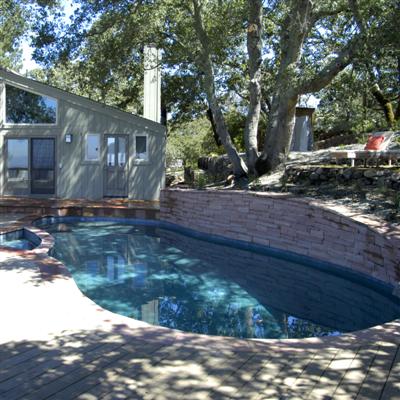
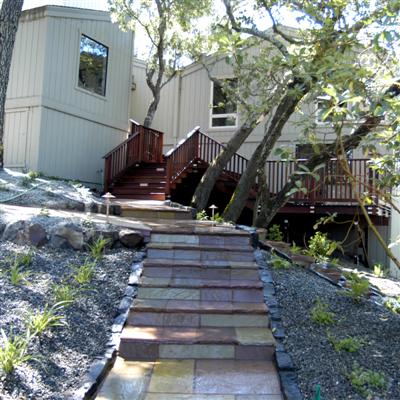
Here are some photos of our most recent finished project. Highlights include Flagstone Entrance Walkway, Brazilian Hardwood Deck and Railings, Copper Landscape Lighting, Flagstone Patios set in sand, Stone Pool Wall and Coping.
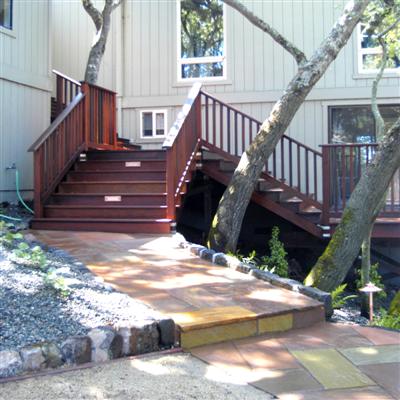
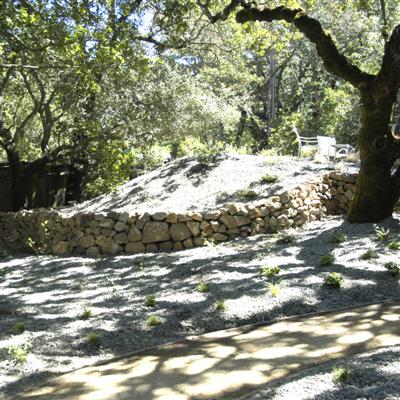
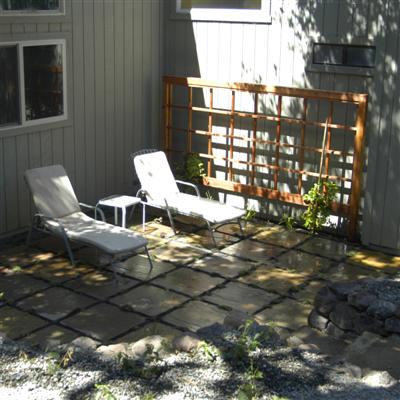
Posted by Michael O'Connell at 09:47 PM | Comments (0)
July 27, 2005
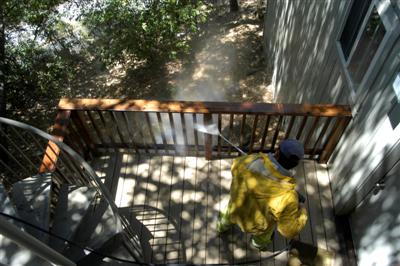
Pressure Washing
As we work to finish a project, we are doing some pressure washing of some existing wood railings, siding, and decking. It is amazing how the luster of wood can be brought back with some Wood Cleaner and a pressure washer.
Pressure washing is a good alternative to replacing old concrete, brick or wood in situations were the material is still sound, but has years of built up dirt, grime and wear. It is often amazing how good a material can look after some cleaning and pressure washing.
We often recommend this on flagstone installations, especially with softer stones, such as Arizona Flagstone, or in shady areas where moss, mildew and dirt may accumulate.
Posted by Michael O'Connell at 10:54 PM | Comments (0)
July 26, 2005
Scheduling your Irrigation in Hot Weather
As summer's heat hits throughout the nation, here are a few tips for making sure your plants endure the heat.
If you are watering by hand, especially with plants in pots, make sure to water frequently. Pots will dry out faster than in ground plantings. For sensitive soft stemmed plants, watering twice per day may be required in extreme heat. If you can move potted plants to protected or shaded areas this will help.
When setting your automatic irrigation controller keep in mind a few things:
1- Up the amount of water scheduled during hot periods
This can be done two ways- by either increasing the duration of the watering, or by increasing the frequency of the watering. If you lawn is on for 10 minutes normally, maybe up it to 15 minutes, or alternatively split it into two start times, one in the morning and one in the afternoon or evening for 6-7 minutes. Splitting watering into two cycles can improve water absorption into the soil, resulting in less run off and more effective watering.
2- Remember to check your settings
Observation is the key to watering. Once you make changes, make sure to keep an eye on things. It may need a bit more or less water depending on the circumstances. If you have upped the watering time for a hot period, remember to adjust it back down if cooler temperatures return.
Remember if you make changes to an automatic controller to set it back to Run or Automatic if required; a failure to do so will prevent the new settings from running, compounding the problem.
3- Probe the soil
A good way to check to see if plants are getting enough water is to probe the soil, brushing back any mulch around the plant and feeling a couple inches into the soil around the plant. The soil should be damp but not sopping wet. Remember that in situations with clay soils, that these typically have a greater water holding capacity and require less watering time. Another methodology for checking soil moisture is to buy a soil moisture probe.
Find more information:
Be Water Wise
East Bay MUD Newsletters
Posted by Michael O'Connell at 11:40 PM | Comments (0)
July 21, 2005
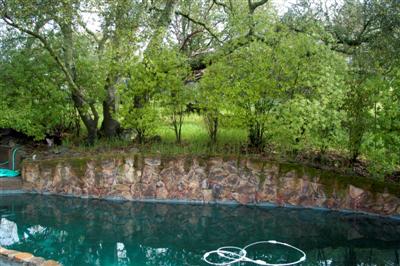
Nearing Completion
We have been working finishing a project up in Sonoma. One of the satisfying parts of completing projects is seeing all the parts of the project come together in a complete and unified whole.
This is especially true of larger scale projects, where a complete transformation is made over an entire property. As I was looking at the before photos of this particular project, I could not believe the difference. The transformative part of the process is always fun to see.
Pool Wall- Before Construction
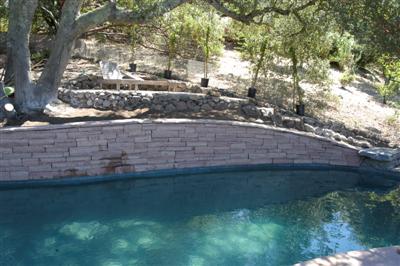
Pool Wall- After Construction
Posted by Michael O'Connell at 06:11 PM | Comments (0)
July 15, 2005
Great People
Sometimes it is easy to take for granted the great people that work for you. We are working hard to complete a project and our crews have been great. They are working in 90+ degree heat all week, and they are really working to get the project done. There is never a complaint, and they work hard all day long.
I was out on the project site doing some site and design administration work and I was tired just watching our guys work, the sweat dripping off my face after briefly walking around the project.
Great people are the starting point, from there it is up to management to turn them into great results.
Posted by Michael O'Connell at 08:37 PM | Comments (0)
July 14, 2005
The Price of Steel
While working on a recent project we needed some custom fabricated stainless steel brackets to reinforce some work we were installing. For a few dozen brackets the cost came to over $1,000 for the materials alone. Our metal fabricator out of Chico, R&D Hydraulics, stated that the price of steel has skyrocketed in the past couple of years, costing almost twice what it would have cost. Pressure from the Chinese and other developing markets has driven the cost up.
Our particular incident is a microcosm of larger pressures on businesses reliant on steel. From our metal fabricator to the auto makers of Detroit, companies are scrambling to deal with the high cost of steel. Here is a good article from the Detriot Free Press detailing the problem.
Posted by Michael O'Connell at 08:02 PM | Comments (0)
July 13, 2005
Common Courtesy
Here is a bit of common courtesy that people soliciting any service should be aware of:
It happens more than you would think. A customer calls our company to his or her property for a free on-site consultation. From there often we compose a bid for landscape services to be done at the project. We send the bid, often via email.
And then we wait, and wait, and wait. It amazes me potential customers fail to follow up on estimates that we give. We issue the estimate and then they fall off the face of the earth. To me this is an issue of common courtesy. While I realize that potential clients are soliciting the services of our company and that the choice of companies is theirs, we often expend a lot of time and energy trying to be of service, even to those clients that do not hire us. For the sake of mutual courtesy all we would ask is an acknowledgement with a simple phone call or email stating that they decided to go with another company or in another direction.
Posted by Michael O'Connell at 09:33 AM | Comments (0)
June 30, 2005
Landscape Transformations- Before & After
One of the great things about the design-build process of landscape construction is we get to take the projects from start to finish. We get to see some great transformations, and have a lot of fun with clients transforming their old yards into beautiful gardens in the process. It may sound like lip service, but few other segments of this or any industry allow that great client interaction. Each project is different and each has it owns challenges, which leads to interesting design and construction solutions for each project we complete.
Below are 3 recently completed projects with Before/After pictures.
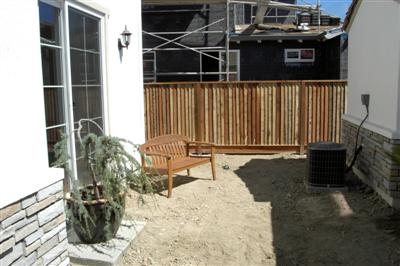
Before
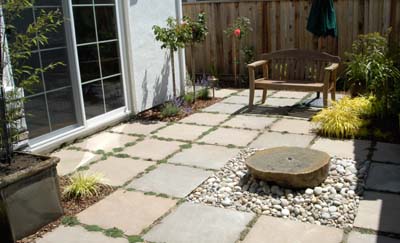
After
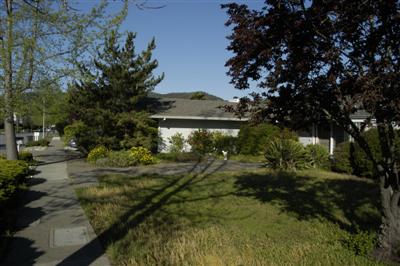
Before

After
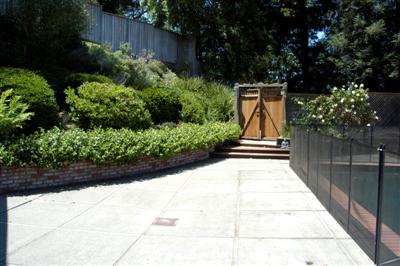
Before
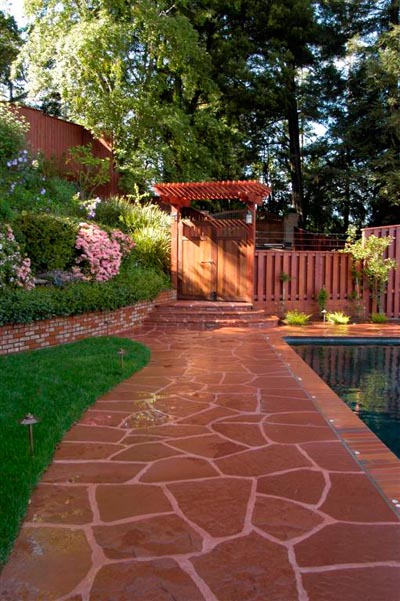
After
Posted by Michael O'Connell at 09:23 AM | Comments (0)
June 27, 2005
Oil Prices & Energy Sustainability
With oil hitting $60 per barrel, one has to hope that eventually we will push for more sustainable energy sources on the small and large scale. The difficult thing to know is where we stand with our current oil based economy.
I have been following this issue closely for the past few months and the predictions give a wide range of possible scenarios. Some experts say that we reached a peak in oil production and that as the lines of supply and demand cross, with no extra production to fill the gap, that we will see a spike in oil prices. A few months back analysts at Goldman Sachs forecast the possibility of $100+ oil in the near future. That would obviously have severe ramifications for the US and world economies.
Conversely, US agencies such as the USGS and EIA (Energy Information Administration) predict oil supplies that will not peak until sometime between 2020-35. This is truly a different forecast than the pessimistic forecasts of the more conservative energy experts.
Unfortunately, it seems the only way we will know any thing conclusive is after we have gone past peak production. What we do not know is if there will be a prolonged plateau instead of a peak, when the peak will happen, and what other energy sources (Natural Gas, Nuclear, Hydrogen Fuel Cell, Wind or Solar) will be able to pick up some or all of the slack.
We do know that US production has peaked (early 1970's) from around 10 million barrels of production a day to a current production of 5 million barrels. It is from this peak that many forecasters predict the world oil peak (using a model know as Hubbert's Peak).
This is a very interesting subject for us. Obviously our fixed business costs and stream of work would be adversely impacted by such scenarios as $100 oil in the near future. It will be fascinating to see how it plays out.
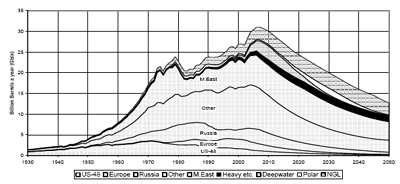
The organization ASPO predicts that oil production will peak around 2007.
Copyright Association for the Study of Peak Oil & Gas Newsletter
Oil Links:
EIA
Hubbert's Peak
Goldman Sachs "Is There Life after $60/bbl?"
Google News Oil Prices
Posted by Michael O'Connell at 08:13 AM | Comments (0)
June 25, 2005
Postcards from the Road
Well this is a feat of our mobile technology. I am posting this entry from I-5 on my Blackberry. We made the jump from regular Nextel Phones to Blackberries for our management staff. It has made keeping track of emails and meetings a breeze. It beats the days when we used to haul around a laptop and cell phone with data connection to check mobile email.
We have always been early adopters at our firm. We had some of the first digital cameras for consumers on the market and we were one of the first firms with a website in our industry and area.
It sure shows have computers have advanced from unstable and bug ridden machines, to stable and powerful communications tools.
Posted by Michael O'Connell at 07:57 PM | Comments (0)
CLCA Awards
I attended the California Landscape Contractor Awards Last night (CLCA) for our region, which includes Marin and Sonoma County. We were fortunate to win an award for a design-build project we completed this last year. There was a lot of tough competition and beautiful projects. See photos of the project below.
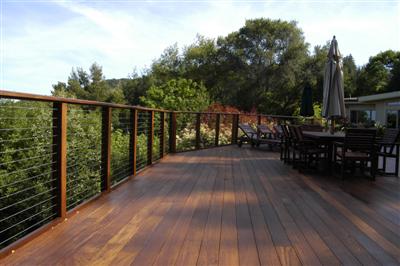
Brazilian Hardwood Deck and Cable Railing
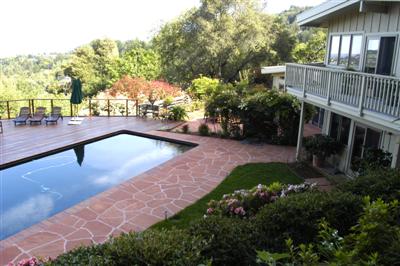
Arizona Flagstone Entrance Pathway and Deck
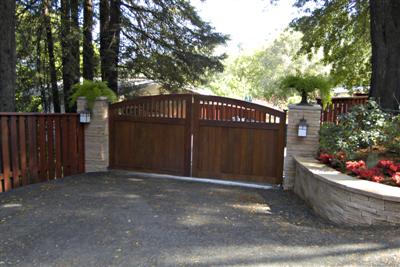
Brazilian Hardwood Entrance Gate and Arizona Stripstone Wall
Posted by Michael O'Connell at 11:10 AM | Comments (0)
June 23, 2005
Service Headache
Sometimes it seems like companies are just trying to beat off their customers with a stick. Take for example one of our large stone suppliers. Every time there is an adventure in itself; changing policies, incorrect billing, incompetent and untrained employees. The list goes on and on. We spend tens of thousands of dollars with this vendor every year. What it does do is make us do it look for other outlets for stone products and use the service oriented companies whose price may be a bit higher.
It's something that we notice with contractors as well. Working with another contractor on a recent project was a frustrating experience. After unanswered calls and missed meetings it wasn't a hard act to follow to look great in the eyes of our client.
Not to be overly promotional, but this is something we try to stress as a point of difference. With cell phones and Blackberries quick and seamless response has become even easier. I just wish many of the other companies we deal with had the same emphasis.
Posted by Michael O'Connell at 01:07 PM | Comments (0)
June 21, 2005
Turned Earth Our New Blog
Welcome everyone to Turned Earth, O'Connell Landscape's blog page. Here you will find commentary on landscape related items, brief articles and notes on questions we receive from clients, and other garden oriented materials.
So Please enjoy!
Michael O'Connell
Posted by Michael O'Connell at 10:22 AM | Comments (0)